


Elliot:
Good morning, everybody. Welcome to our 2026 employment law changes webinar: What Your Business Needs to Know.
Today’s speakers are myself, Elliot, Senior Legal Solutions Consultant, and we also have Saeidul with us, one of our Senior Associates in the Employment and Health and Safety team.
Before we begin, just a couple of quick housekeeping items. You will receive the recording and slides in your email. If you could submit your questions in the Q&A box, we’ll be able to answer them at the end. Please do complete the feedback survey after the webinar.
Whether you’re a business manager, an HR manager, or even in-house counsel, by viewing this webinar you’re eligible to receive a complimentary consultation with LegalVision and myself to discuss how we can help your business. To claim this, all you need to do is leave your contact details in the survey that appears when the webinar ends or contact us via our website and we will reach out to you.
I’m going to pass through to Saeidul, who’s going to discuss some of the relevant parts and the body of our webinar today.
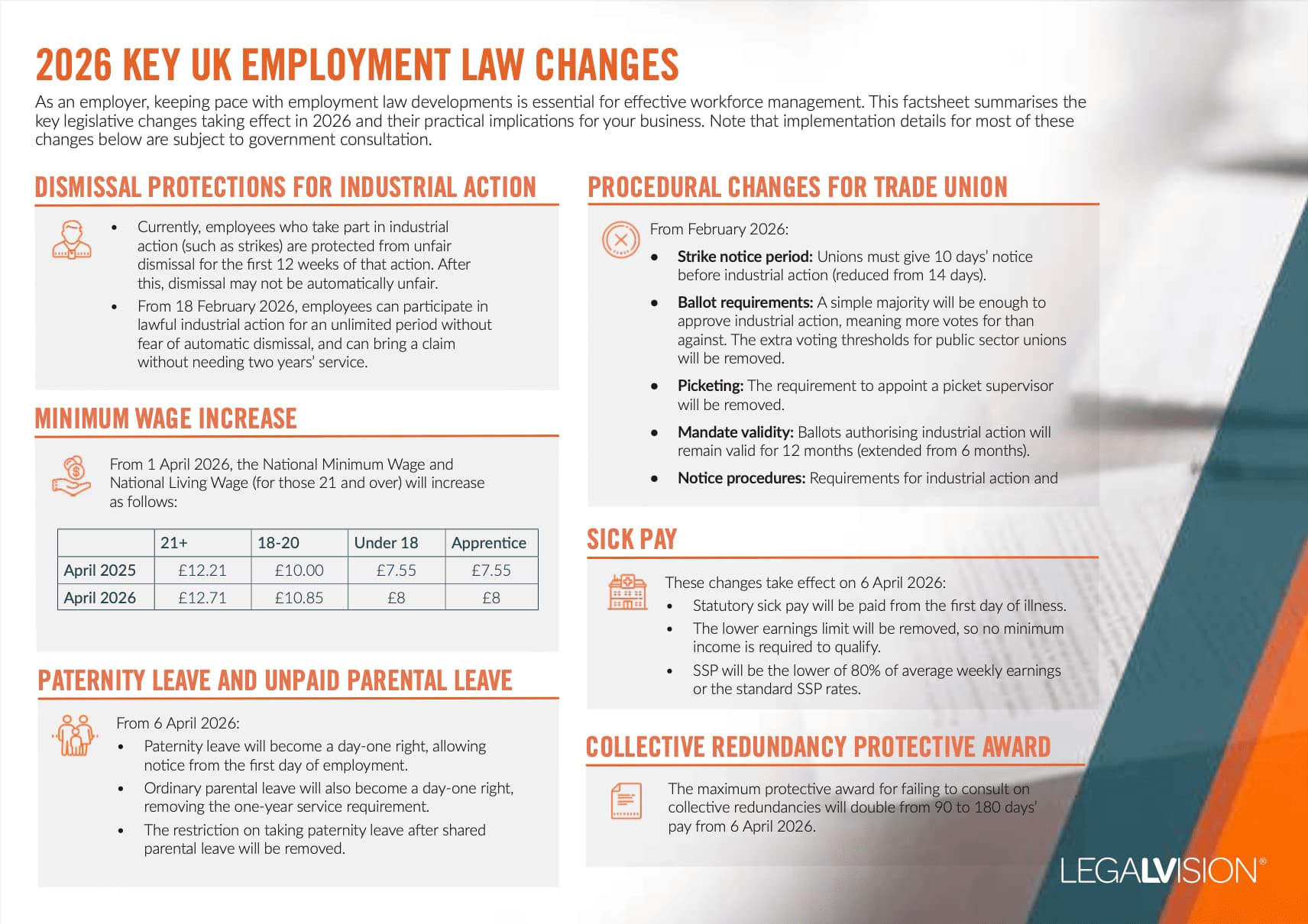
This factsheet summarises the key legislative changes taking effect in 2026 and their practical implications for your business.
Saeidul:
Thank you very much, Elliot.
In terms of today’s discussion, as Elliot mentioned, we’ll be talking about all things employment-law-related and some of the changes coming up this year. We’ll go for a brief introduction before looking at those changes, mainly for this year and some for next year too.
We’ll look at what this looks like in practice, what the consequences could be if we don’t get it quite right, and what we can do to reduce our risk. We’ll then look at the key takeaways before we wrap up with our Q&A at the end of the session. So please do submit your questions in the box below.
In terms of, as an employer, keeping up with employment law changes is really essential for effective workplace management and compliance with legislation as well. This is to try and ensure that you minimise legal risks as much as you can and avoid any unnecessary escalation, be that with employees themselves or legally speaking through the employment tribunal system.
The Employment Rights Bill was introduced last year, or came into fruition mainly last year, and came into effect on 18 December last year as well. Essentially, what it did was introduce a significant number of changes to existing employment laws. The changes outlined by the Bill are going to be implemented incrementally over time.
That means not all of the changes will come into effect immediately or even at the same time. There will be more of a staggered approach to this. While the Bill does set out a significant number of changes to employment law, this webinar will really just focus on the key changes.
So some of those key changes for 2026. Effective from 1 April, we’ve got the usual changes to the minimum wage and the National Living Wage for those over the age of 21. For employees and workers aged 21 and over, it will be increased from £12.10 at the moment to £12.71, representing a 5.0% increase.
For employees and workers aged 18 to 20, it’ll increase from £10.00 to £10.85. For employees and workers aged under 18 and for apprentices, it will be £8.00, rising from £7.55.
From 6 April, there’ll also be updates to the usual statutory rates for payments for things like maternity pay and paternity pay. That will be £194.32, up from £187.18 this year. Statutory sick pay will also increase, with the usual increase. That’s currently £118.75, but it will increase to £123.25, or 80% of the employee’s average weekly earnings, whichever is lower.
Now, some of these significant changes and granular detail around that. We’ll start with statutory sick pay. This will now be payable from the first day of sickness absence rather than the fourth day at the moment, where we have a four-day waiting period, meaning the first three days are not covered and then the fourth day onwards is when you start paying someone the statutory sick pay rate.
The lower earnings limit at the moment will also be removed, meaning more people are going to qualify for sick pay. Because of the removal of the waiting period, it means we need to account for that fact as well. We’ll go into more detail later on in this session.
I also mentioned some of the other changes around paternity and maternity, but one of the specific changes for paternity leave is that it will become a day-one right. That means it will enable employees to give notice of that leave from the very first day of their employment, as opposed to the current requirement that they need at least 26 weeks of continuous service.
In practice, what that means is you could have someone who starts with you, for example, on 7 April and then becomes immediately eligible to claim paternity leave if they meet the other eligibility requirements as well. That is something employers will need to start planning for.
Ordinary parental leave will also become a day-one right. At the moment, employees need to have worked for employers for at least a year to be eligible for that. That is quite a significant change, similar to paternity leave as well.
Additionally, there will be some further changes around collective redundancy and the protective award for that. The maximum award for failing to inform and consult employees or their representatives will double from 90 days’ pay per employee to 180 days’ pay. That is quite a significant increase in relation to when things go wrong with collective redundancies.
Sexual harassment will also change slightly in that it will become a qualifying disclosure under whistleblowing laws. At the moment, employees who raise these issues don’t necessarily qualify as whistleblowers, but they will from April onwards. That means employees who report sexual harassment to their employers will be protected from any unfair treatment.
There are also changes in relation to the gender pay gap and menopause action plans as well. While this is initially going to be voluntary, from 2027 some employers will need to start creating an action plan for menopause support and also a gender pay gap report, which is quite similar to other reporting obligations.
Another point to note is that trade unions will have a simpler process for workplace recognition. At the moment, there is quite a convoluted process to get that recognition by employers, but this will be simplified moving forwards, meaning more trade unions may be recognised by even small businesses.
From April also, we’ll see the creation of the Fair Work Agency, which is going to be a new agency established to bring together existing enforcement bodies and enforce employment rights. They’ll have the ability to enforce rights around holiday pay and statutory sick pay, for instance.
From October, later in the year, we have some changes in relation to harassment, meaning that employers will become liable for third-party harassment, for example from customers or clients. That will apply to all harassment types. Employers must also take all reasonable steps to prevent sexual harassment. Currently this is limited to reasonable steps, but it will be expanded to all reasonable steps, so there will be a broader scope.
For tipping, employers will be required to consult with workers or their representatives before creating a tipping policy and to update that policy every three years. This mainly affects the hospitality sector.
A major change coming in next year is ordinary unfair dismissal protection. Initially, bodies were pushing for this to be a day-one right, but in the end it was agreed that protection will apply from six months of continuous employment. That is a significant change from the present situation, where employees need two years of continuous employment to claim ordinary unfair dismissal.
Additionally, and this is quite important and perhaps under-reported, the limit on compensatory awards for unfair dismissal will be removed, meaning it will be uncapped.
There is also going to be a change around fire and rehire. This basically means when you dismiss someone and then rehire them on worse terms. In most cases that will now constitute automatic unfair dismissal.
So what does this look like in practice? For national minimum wage and living wage increases, and other statutory payment increases, you’ll need to review all employee and worker pay rates before April and adjust your payroll systems accordingly.
For example, if you’ve got an employee aged 19 earning £10 an hour, you’ll need to increase that to £10.85 to comply with the legislation. It’s a good idea to start planning financially, taking this into account in budgets and preparing letters to employees affected by the changes.
With statutory sick pay, instead of waiting until the fourth day of sickness absence, you’ll need to pay from day one. If an employee calls in sick on a Monday, it will be payable from the Monday rather than the Thursday. You’ll also need to pay sick pay to lower earners who previously didn’t qualify due to the earnings threshold.
That means you need to consider who is eligible more carefully and revise any sickness absence policies and relevant contract clauses.
With paternity leave and parental leave, employees can request this immediately upon starting employment. That brings it in line with maternity leave. A new father starting on a Monday could give notice to take paternity leave immediately. This is something to plan for in recruitment.
With collective redundancies, if you plan to make 20 or more redundancies within a 90-day period, you must properly consult and inform employees. You should update redundancy policies and ensure the consultation process is robust, because failure could lead to 180 days’ pay per affected employee.
With sexual harassment qualifying as whistleblowing, employees raising concerns internally will have whistleblower protection. You cannot dismiss or subject them to detriment for making that disclosure. This forms part of the government’s plan to eradicate workplace harassment.
Third-party harassment liability means you could be liable if a customer, client, supplier or contractor harasses your employee, unless you have taken all reasonable steps to prevent it. That means reviewing policies, training staff, and potentially issuing conduct expectations for workplace events.
For hospitality businesses, you’ll need to formally consult staff before implementing or changing tipping policies and document the consultation process.
For unfair dismissal at six months, employers need to think carefully about managing employees when they first join. Probation periods will become more important in practice. If things are not working out, you need to address them promptly rather than waiting until the end of probation.
Because the compensation cap is being removed, the process followed will be extremely important.
Fire and rehire restrictions mean you cannot dismiss employees and rehire them on worse terms as a negotiation tactic. That will be automatically unfair in most cases unless there is genuine financial difficulty.
The bottom line is employers cannot dismiss employees for refusing contractual changes and attempt to rehire them on those changes unless facing genuine financial difficulty.
Now, the consequences of not getting it right can be substantial, particularly with minimum wage. HMRC can issue penalties of up to 200% of underpayment and publicly name employers. Workers can also bring tribunal claims for unlawful deduction of wages.
For statutory sick pay, employees can bring tribunal claims and HMRC can investigate. The new Fair Work Agency will also have enforcement powers, including issuing notices of underpayment and tribunal proceedings on behalf of employees.
Denying day-one rights of paternity or parental leave can have discrimination implications, and compensation can be uncapped.
For redundancy consultation failures, the protective award has doubled, so it is important to get the process right.
For sexual harassment, tribunals can award compensation with an uplift of up to 25% for failing to take all reasonable steps. Dismissing or subjecting an employee to detriment for reporting harassment can result in automatic unfair dismissal or whistleblowing claims.
For tipping, failures can cause reputational damage and tribunal claims.
For unfair dismissal at six months with uncapped compensation, employers must manage probation periods carefully, with regular reviews and documentation. Shorter probation periods may be appropriate.
For fire and rehire, dismissals will be automatically unfair in most cases, with uncapped compensation and reputational risk.
So what can you do to reduce these risks? Conduct a pay audit, update policies and contracts, revise absence and family-friendly policies, create or update whistleblowing and tipping policies, avoid fire and rehire except as a last resort, and begin planning for pay gap reporting and menopause action plans. Early adoption is advisable.
Also, take legal advice, because it is easy to get these things wrong.
Key takeaways are: review pay rates, sick pay procedures and family leave policies before April; implement harassment prevention measures before October; prepare for increased unfair dismissal risk at six months; and avoid fire and rehire. Early preparation and documentation are critical.
That wraps up the main talking points. I’ll hand back to Elliot.
Elliot:
Saeidul, thank you so much for that. Really informative and lots of useful information. That concludes the main part of our webinar.
You might also find our publication useful. It will be available in the resources tab or via the QR code on the slide. You may also be interested in our upcoming webinar, Employee Versus Contractor: Avoiding Costly Mistakes in Your Business, taking place on Thursday 26 March at 11:00 am.
We’re going to answer your questions shortly. We may not be able to answer all of them today. Please do submit a request for a free consultation and we can discuss those points in more detail.
While you submit questions, I’ll briefly talk about LegalVision’s membership. By becoming a LegalVision member, you’ll receive access to unlimited support from our team of 100-plus specialist lawyers, covering all business-as-usual legal needs, including employment.
This includes unlimited drafting and review of employment contracts, policies, performance and termination documentation, and more. You’ll also receive unlimited legal advice consultations across employment, health and safety and other business areas.
There are also additional services available. As a LegalVision member, you don’t have to worry about hourly legal costs. You can think of it as having access to your own in-house counsel.
To learn more, please request a free consultation when the survey appears at the end of the webinar. I’ll now hand back to Saeidul for the Q&A.
Saeidul:
Thank you very much, Elliot. We’ve had quite a lot of questions come through, so I won’t be able to cover them all, but you can claim the complimentary consultation as mentioned.
We’ve had a question about bereavement leave. At the moment, there is no statutory right to general bereavement leave, except for parental bereavement leave where a parent loses a child under 18. A general bereavement leave right is expected in 2027, but details such as paid or unpaid and duration are not yet confirmed.
We’ve also had several questions about probationary periods. Businesses need to think carefully about probation because unfair dismissal claims will be possible from six months. Many businesses have six-month probation periods, so they may need to shorten them and introduce regular reviews and documentation.
Another question was whether day-one paternity leave includes paternity pay. It does not. Paternity pay still requires 26 weeks’ service and other eligibility criteria. The change applies only to leave, not pay, unless enhanced company policies apply.
We also had a question about changing terms and conditions after fire-and-rehire changes. Employers can still consult and agree changes with employees where there is a business rationale. The restriction applies where employees are dismissed and rehired on worse terms.
There was also a question about zero-hours workers. No major changes in 2026, but expected changes in 2027 around predictable hours and compensation for cancelled shifts.
Copies of slides and the recording will be sent automatically to registered attendees.
Saeidul:
So what I would say about that is that the process will be similar to what we’ve got at the moment, which is that you still need to have a business case of some sort that explains the rationale for these changes. Equally, there should be a consultation process with the employees to explain the rationale and to consult them to see if they’ve got any issues with it and to come to a mutual agreement.
At the end of the day, you don’t want to make unilateral changes. However, when the law changes, it will become harder to make certain changes which will become automatically unfair, specifically in relation to hours of work, days of work, and even pay as well. That applies if you dismiss the staff for refusing the change and then rehire them on those less favourable terms.
A code of practice, as I mentioned, will come into place in 2027 around that as well, with further information. But what that doesn’t mean is that you can’t still consult with your employees and come to an agreement around hours of work and pay as well if there is a genuine business need for that. Ultimately, this change covers a situation where specifically you fire them and then rehire them on those less favourable terms.
If you actually consult them and they agree to them, then this isn’t impacted by the upcoming change. So you can still do that with your employees without any impact, so long as they agree, of course, to that change. So I hope that answers your question around that as well.
I’ll just have a look at what other questions we’ve got. We’ve got a question about zero-hours workers and whether there will be changes. At the moment, no, nothing’s really going to be changing around zero-hours workers, but there are going to be changes coming in place in 2027.
That will be around zero-hours workers being able to ask for more fixed periods of employment and fixed hours, but also being able to receive some compensation if shifts are cancelled at the last minute as well. That will be coming into place next year. The intricacies of that will be confirmed in due course by the government. As I mentioned earlier, we’ll likely have a webinar on that closer to the time and go through it in more specific detail at that stage.
We’ve got a general question about copies of the slides and recording. They’ll just be automatically sent to you if you’ve registered for this webinar, so keep an eye out for that. If you don’t receive them for whatever reason, just reach out to our team and we’ll be more than happy to assist you.
I’ll take one final question. We’ve got a question here about agency workers and whether contractors or workers are going to be entitled to any statutory sick pay.
Well, that boils down to employment status. If someone is truly a contractor, which means they’re self-employed, then there’s no entitlement to statutory sick pay. It’s as simple as that. They’re self-employed and not entitled to employment benefits such as statutory sick pay.
But if someone has worker status, which is a different type of status, then they may have eligibility and may meet the eligibility requirements for that because of the changes coming into place. It will be a day-one right and they’re also removing the lower earnings limit around that, meaning it will capture more and more agency workers.
So in short, yes, agency workers will be affected by that — not contractors, but those with worker status. So hopefully I’ve answered your question there as well.
I’m going to wrap it up there in terms of questions. Apologies, I’ve not been able to get around to them all. There are quite a number of questions, but as I mentioned, you can claim your free consultation so we can go through that in more detail. Otherwise, I’ll hand over to Elliot just to go through the last steps.
Elliot:
Thanks so much, Saeidul. So that’s all we have time for today. Unfortunately, sorry if we’ve not been able to answer your question, but thank you so much for your participation and everyone’s engagement.
Please do submit your details in the survey at the end for assistance with any questions that we weren’t able to answer or to learn more about how our membership can help you and your business.
While this is a free webinar, we really value feedback. If you could please complete the 30-second survey at the end, it’s greatly appreciated.
We appreciate your feedback – your submission has been successfully received.


