


Summary
- Redundancy must be genuine: the role, not the person, is no longer needed, and selection must be fair and free of discrimination.
- Employers proposing 20 or more redundancies at one establishment within 90 days must consult collectively and notify the Redundancy Payments Service using form HR1 at least 30 (or 45) days before the first redundancy (depending on the number of redundancies), and the maximum protective award is now 180 days’ pay.
- From 1 January 2027, dismissing staff and rehiring them on worse terms becomes automatically unfair in most cases under the Employment Rights Act 2025.
- This guide explains restructuring and redundancy compliance for UK businesses.
- LegalVision’s business lawyers specialise in advising clients on employment and redundancy.
Tips for Businesses
Map the roles at risk before you act. Consult early and in writing, and keep records. Use objective, non-discriminatory selection criteria. Notify the Redundancy Payments Service on form HR1 if 20 or more roles go. Check current redundancy pay and notice figures before you calculate. Speak to an employment lawyer at LegalVision about changing contract terms without triggering the fire and rehire rules


Redundancy is a dismissal that happens when your business no longer needs a particular job done. If you restructure and a role disappears, UK law expects a fair process before anyone loses their job: warn and consult the affected staff, use objective selection criteria, look for suitable alternative work and give proper notice and redundancy pay. Two changes matter now. Since 6 April 2026, the maximum protective award for failing to consult collectively has doubled to 180 days’ pay. From 1 January 2027, the Employment Rights Act 2025 makes fire and rehire automatically unfair in most cases. Get the process wrong and a tribunal can rule the dismissal unfair. This article will explain some legal aspects of restructuring and redundancy for business leaders.
What Restructuring and Redundancy Mean
Restructuring means changing your organisation or its job roles. You might merge teams, drop activities that no longer fit your plans, or bring in technology that changes how the work gets done.
Sometimes that leaves you with roles you no longer need. Redundancy is the dismissal that follows when a job, not the person, is no longer required.
Steps to Take Before Making Redundancies
Redundancy affects people’s livelihoods, so treat it as a last resort. Before you start, look at what else could close the gap. You could reduce or stop overtime, pause recruitment, end contractor or freelancer arrangements, introduce short-time working, agree temporary lay-offs or offer voluntary redundancy.
Each option buys you room without a compulsory dismissal. Write down what you considered. If a claim follows, a tribunal will want to see you looked at alternatives first.
Continue reading this article below the formCall 0808 196 8584 for urgent assistance.
Otherwise, complete this form, and we will contact you on the same business day.
How to Keep the Redundancy Process Fair
A genuine business reason is not enough on its own. The process has to be fair too. That means fair selection, proper consultation and a real look at alternative work.
Selecting Staff Fairly
Use objective criteria you can evidence. Skills, experience, qualifications and disciplinary records are common measures.
Never use any discriminatory criterion. Age, sex, race, disability, pregnancy, maternity or part-time status cannot come into it. Selecting on those grounds could render a dismissal as unfair and lead to discrimination claims.
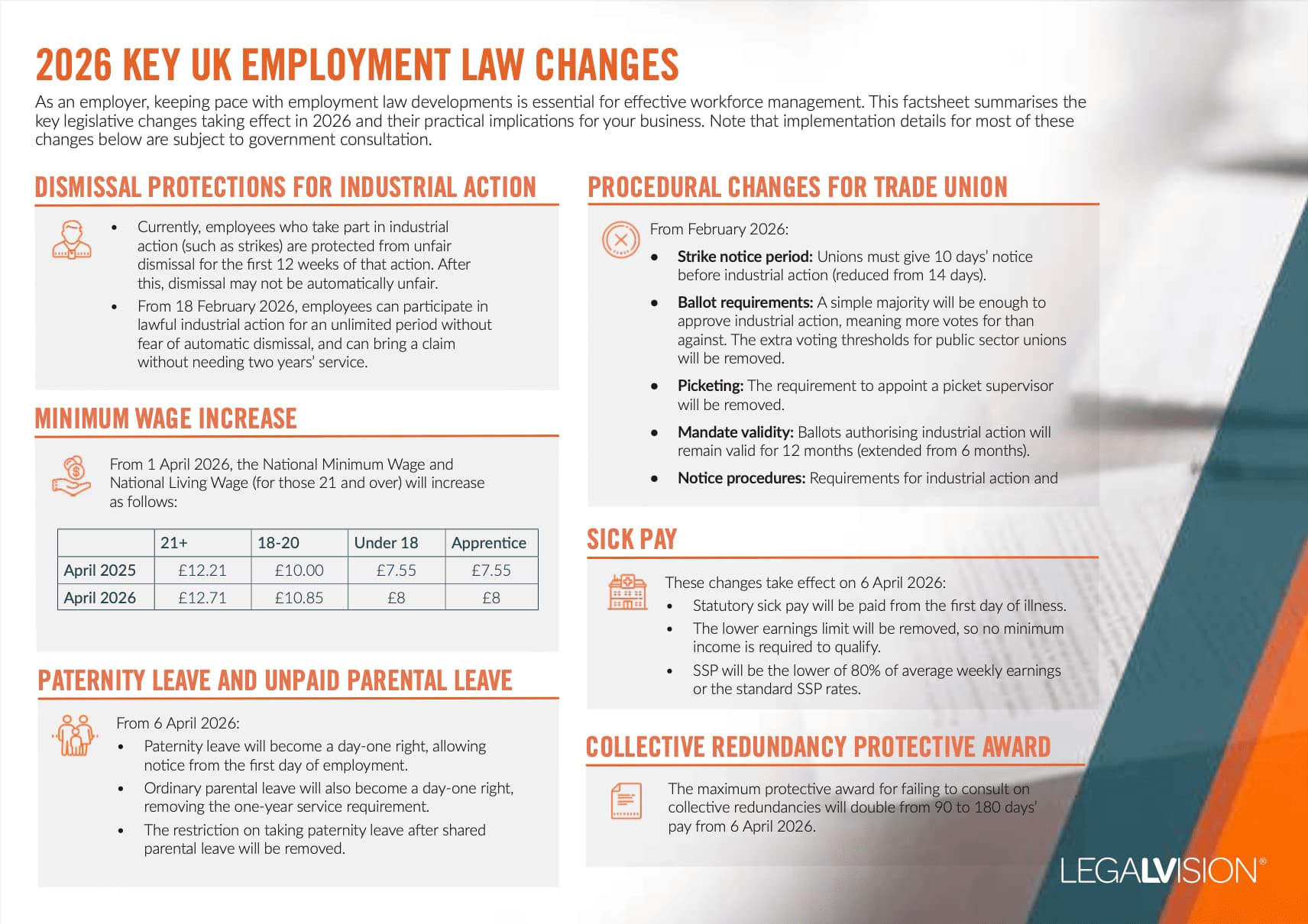
This factsheet summarises the key legislative changes taking effect in 2026 and their practical implications for your business.
Consulting Your Staff
You must consult before any decision is final. For individual redundancies, there is no fixed format, but you need to explain the situation, hear the employee’s response, and consider it carefully. You must also follow any redundancy policies you have in place.
Collective rules apply when you propose 20 or more redundancies at one establishment within 90 days. Then you must consult employee or trade union representatives, notify the Redundancy Payments Service on form HR1 before consultation starts, and allow the minimum consultation period to take effect before any dismissal.
Notify at least 30 days in advance for 20 to 99 redundancies, and 45 days in advance for 100 or more. Those same 30- and 45-day periods are effectively the minimum consultation periods before you can dismiss. Miss the HR1 notification and the fine is unlimited.
Offering Alternative Employment
You must look for suitable alternative roles inside the business before dismissing. If you offer one, the employee can trial it for four weeks without losing their redundancy rights. You can agree a longer trial in writing.
Whether a role is suitable depends on its pay, hours, location and status. If an employee turns down a genuinely suitable offer without good reason, they can lose their statutory redundancy pay.
Redundancy Pay
Employees with two years’ continuous service qualify for statutory redundancy pay. The amount depends on age and length of service:
- half a week’s pay for each full year worked under age 22;
- one week’s pay for each full year worked aged 22 to 40; and
- one and a half weeks’ pay for each full year worked aged 41 or over.
Service counts up to 20 years. From 6 April 2026, a week’s pay is capped at £751, so the maximum statutory payment is £22,530. Redundancy pay is tax free up to £30,000.
Giving Notice
You must give at least the statutory notice period, based on service:
- one week if employed between one month and two years;
- one week for each full year employed between two and 12 years; and
- 12 weeks if employed for 12 years or more.
The contract may set a longer period. You can pay in lieu of notice if the contract allows it. Notice pay is based on average weekly earnings over the 12 weeks before notice starts.
Time Off to Look for Work
Employees with two years’ service are entitled to reasonable paid time off during their notice to look for work or arrange training. You do not have to pay more than 40% of a week’s pay for that time.
Changing Contracts and Fire and Rehire
Restructuring does not always mean redundancy. You might instead change roles, pay, hours, location or benefits. Most contract changes need the employee’s agreement, unless the contract clearly allows the variation.
If staff will not agree, some employers dismiss them and offer re-engagement on the new terms. This is fire and rehire.
Plan any contract change around real consultation and agreement. Forcing new terms through dismissal will carry serious legal risk.
“Many employers treat consultation as an announcement rather than a conversation. They decide the outcome first, then run a process to confirm it, and a tribunal spots that in the paperwork within minutes. Start consulting while the plan can still change, and most of the risk goes away.”

What Changes for Unfair Dismissal in 2027
One more change affects redundancy. Today, most employees need two years’ service to claim ordinary unfair dismissal. From 1 January 2027, that qualifying period drops to six months and the cap on the compensatory award is removed. More of your staff will be able to challenge an unfair redundancy, so a sound process matters more than ever.
Key Takeaways
Restructuring can make your business more efficient, but redundancy is a dismissal and the law treats it seriously. Consider alternatives first, such as short-time working or reducing overtime. If you go ahead, select fairly, consult properly, look for alternative roles and give correct notice and redundancy pay. Watch the timeline: the maximum protective award doubled to 180 days in April 2026, and fire and rehire becomes automatically unfair from January 2027.
LegalVision provides ongoing legal support for businesses through our fixed-fee legal membership. Our experienced employment lawyers help businesses manage contracts, employment law, disputes, intellectual property, and more, with unlimited access to specialist lawyers for a fixed monthly fee. To learn more about LegalVision’s legal membership, call 0808 196 8584 or visit our membership page.
Frequently Asked Questions
How is statutory redundancy pay calculated?
It depends on age and continuous service. Employees get half a week’s pay per year under 22, one week per year aged 22 to 40, and one and a half weeks per year at 41 or over. Service is capped at 20 years and weekly pay at £751.
Do I have to offer a redundant employee another job?
Yes, if a suitable alternative role exists in your business you must offer it before dismissing. The employee can trial the new role for four weeks, or longer if agreed in writing, without losing their redundancy rights. Suitability depends on pay, hours, location and status.
What is enhanced redundancy pay?
It is redundancy pay above the statutory minimum. You might owe it because the contract promises it, or because paying more has become a custom in your business or industry. Redundancy payments are tax free up to £30,000.
When must I consult employees collectively?
When you propose 20 or more redundancies at one establishment within 90 days. You must consult representatives and notify the Redundancy Payments Service on form HR1.
From 2027, you will count redundancies across the whole organisation, not just one site. A specific implementation date for this is yet to be confirmed.
We appreciate your feedback! Request your free consultation now.


