
Summary
- Employers must take all reasonable steps to prevent sexual harassment of their employees under the Equality Act 2010.
- Employers are liable for harassment by third parties, such as clients and customers, if they fail to take all reasonable steps to prevent it.
- A tribunal can increase compensation by up to 25% where an employer breached the duty to prevent sexual harassment.
- This article explains the sexual harassment prevention duty for employers in England, Wales and Scotland.
- LegalVision’s business lawyers specialise in advising clients on employment law and workplace harassment.
Tips for Businesses
Review your sexual harassment policy against the all reasonable steps standard. Extend your risk assessments to clients, customers and other third parties. Train managers to recognise and escalate complaints. Keep an incident register and record why you decided any step was not reasonable for your business.


On this page
Employers in England, Wales and Scotland must take all reasonable steps to prevent sexual harassment of their staff. You are also responsible if a client, customer or other outsider harasses one of your employees and you did not do enough to stop it. If an employee wins a sexual harassment claim and you failed in this duty, a tribunal can increase their compensation by up to 25%. The Equality and Human Rights Commission, the equality watchdog, can also take enforcement action against your business. This article explains the new legal obligations on employers, how the law is changing, and what practical steps businesses should take to remain compliant.
What Is Sexual Harassment?
Sexual harassment is any unwanted physical, verbal or non-verbal conduct of a sexual nature that violates someone’s dignity or creates an environment that is:
- intimidating;
- hostile;
- degrading;
- humiliating; or
- offensive.
Examples of things that could be considered sexual harassment include:
- making inappropriate sexual comments or jokes;
- unwanted physical contact like touching, hugging or kissing;
- staring or making offensive gestures of a sexual nature;
- asking inappropriate questions about someone’s sex life; and
- displaying pornographic or sexually offensive material.
The key issue is whether the behaviour was unwanted and made the person feel violated, intimidated or offended. The harasser does not need to intend harm. What matters is how their behaviour affected the person receiving it.
What Does the Law Say?
As an employer, you are responsible for ensuring your staff do not engage in any form of sexual harassment. This responsibility extends beyond the physical workplace. You can be held liable if one of your employees sexually harasses someone in work-related settings and situations outside the office.
This includes:
- company social events and gatherings;
- business trips and off-site meetings; and
- communications on social media relating to work.
Call 0808 196 8584 for urgent assistance.
Otherwise, complete this form, and we will contact you on the same business day.
The Duty to Take All Reasonable Steps
Under section 40A of the Equality Act 2010, you must take all reasonable steps to prevent sexual harassment at work. This includes harassment by colleagues, customers, clients and contractors. Since 30 October 2026, the law has required employers to take all reasonable steps, regardless of business size.
You must act before harassment occurs, rather than wait for a complaint. Identify where your workers face risks and take steps to prevent harassment. If harassment occurs, take action to stop it happening again. You must also regularly review the steps you take.
The EHRC guidance suggests you:
- consider the risks of sexual harassment in your workplace;
- consider what steps could reduce those risks;
- decide which of those steps are reasonable for your business; and
- implement every step you decide is reasonable.
What counts as reasonable depends on your business. The EHRC guidance lists factors including:
- your size and resources;
- your sector;
- the working environment;
- the risks present;
- your contact with third parties; and
- the time, cost and disruption of a step weighed against its benefit.
It also asks whether your steps are working, so a further incident may show you need to do more.
What Laws Do You Need to Comply With?
The duty to prevent sexual harassment is set out in the Equality Act 2010. The Worker Protection (Amendment of Equality Act 2010) Act 2023 introduced it on 26 October 2024.
The Employment Rights Act 2025 raised the standard to all reasonable steps from 30 October 2026. The same Act made employers liable for harassment by third parties. Reports of sexual harassment can also be protected disclosures under the Employment Rights Act 1996.
What Happens If You Do Not Take All Reasonable Steps?
1. Compensation Uplift
If a worker succeeds in a sexual harassment claim, the tribunal must consider whether you complied with the duty. If it finds a breach, it may increase the worker’s compensation by up to 25%, reflecting how far you fell short.
2. Liability for the Harassment
If you fail to take all reasonable steps to prevent harassment, you may lose your defence against a claim. Your business may be liable if colleagues or third parties harass workers during their employment, even if you were unaware of it. This applies to all forms of harassment, not just sexual harassment.
3. Other Exposure
You should also consider other exposures, such as:
- compensation is uncapped and can include loss of earnings, injury to feelings and personal injury;
- there is no qualifying service period, and job applicants are protected;
- mishandling a worker’s complaint can support claims for discrimination or victimisation; and
- tribunal decisions are published online, and defending a claim costs management time and legal fees even if you win.
4. Regulator Enforcement
The Equality and Human Rights Commission (EHRC) can investigate your business even if no harassment has occurred. It can require you to take action, enter into a binding agreement or seek a court injunction. Workers can also report concerns about potential breaches directly to the EHRC.
“A staff handbook would not offer you any defence unless you act on it. Tribunals ask what you actually did to stop harassment, including harassment by your clients and customers.”

Harassment by Third Parties
From 30 October 2026, employers are also liable when a third party harasses one of their employees in the course of their employment.
A third party is anyone other than you or your workers. This includes:
- customers;
- clients;
- contractors;
- suppliers;
- service users;
- patients;
- students;
- delegates;
- members of the public;
- friends and family of colleagues; and
- agency workers supplied to you.
Liability is not limited to sexual harassment. It also covers:
- harassment related to age;
- disability;
- gender reassignment;
- race;
- religion or belief;
- sex and sexual orientation; and
- less favourable treatment for rejecting or submitting to harassment.
If a customer makes sexual comments to a retail assistant, your business could face legal consequences if you failed to take all reasonable steps to prevent the harassment. A tribunal will consider what steps you could reasonably have taken. You do not need to prepare for extremely unlikely situations or prevent every incident, but you must take reasonable steps to reduce the risk.
What Reasonable Steps Should Employers Take?
You need to be able to show the reasonable steps you have taken to prevent sexual harassment in the workplace. Some examples are below.
1. Registers
Your business should have a reporting register that records incidents, actions taken, and next steps. A register helps you monitor a situation and review your company’s approach.
2. Sexual Harassment Policy
Implement a sexual harassment policy and distribute it to your workforce. The policy sets out your company’s stance. It also tells employees how to report incidents and the processes that will be taken when incidents occur. This encourages people to come forward with confidence.
3. Risk Assessments and Training
By providing training and conducting risk assessments for events outside of work, you can demonstrate:
- the reasonable steps you are taking; and
- that there is a company-wide effort to create a safe working environment.
Your risk assessments should also cover third parties. Look at where your staff deal with clients, customers or the public and what could go wrong.
4. Reporting Channels and Processes
The most important step is a clear reporting channel for when sexual harassment occurs. A good channel lets people be open and honest about what happened. They also know there is a thorough procedure in place to investigate the situation and remedy it.
5. Protecting Staff Who Report Sexual Harassment
A reporting channel only works if people trust it. Since 6 April 2026, reporting sexual harassment can count as legally protected whistleblowing.
This raises the stakes for managers’ responses. Picture a sales assistant who reports a regular customer for sexual comments. Her manager then cuts her shifts to keep the peace. That response could lead to a whistleblower claim in addition to any harassment claim.
To reduce this risk:
- brief managers that a complaint must not affect someone’s shifts, pay or progression;
- record the reasons for any change to a person’s role after they report; and
- check in with the person who reported throughout the investigation.
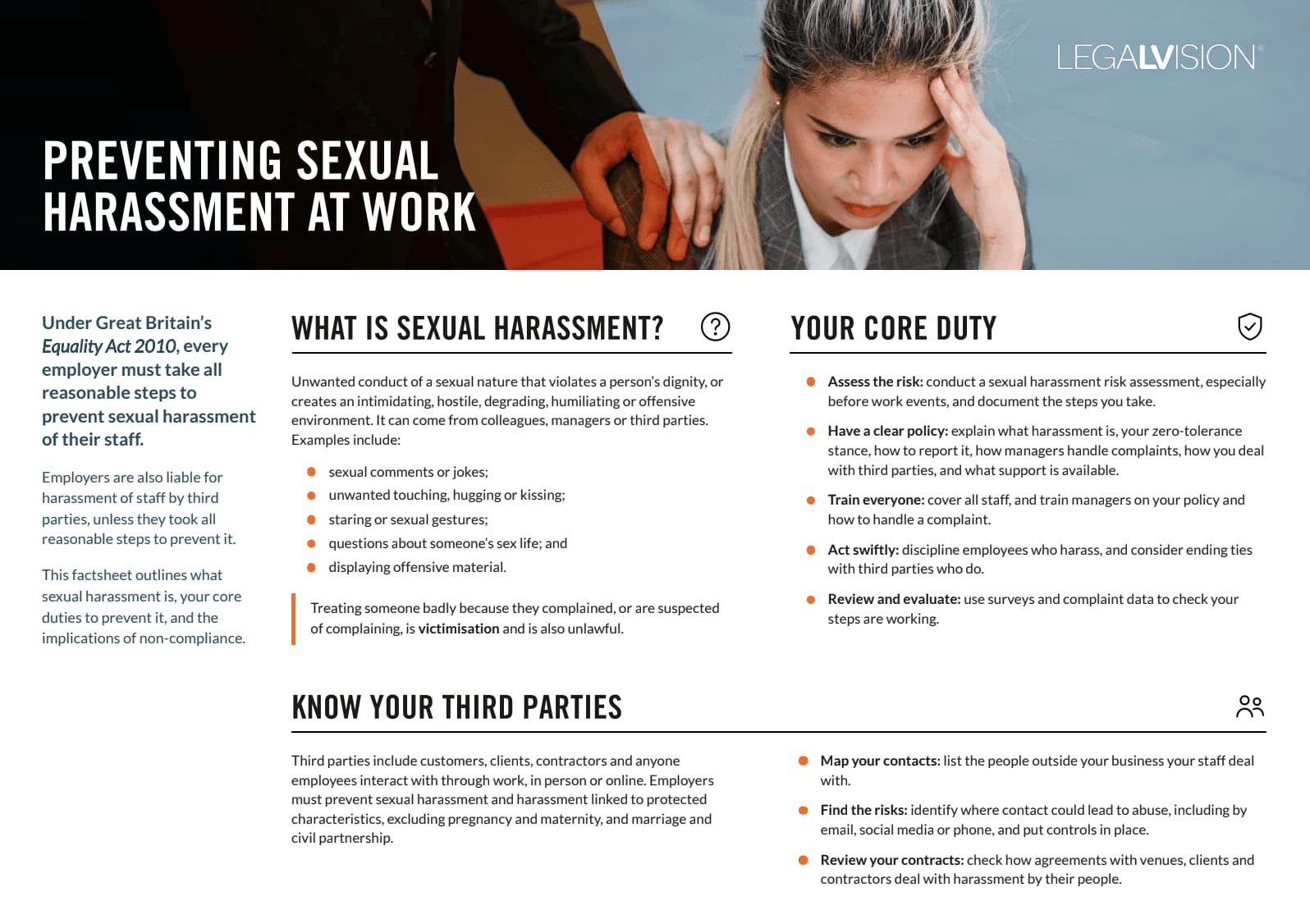
Under Great Britain’s Equality Act 2010, every employer must take all reasonable steps to prevent sexual harassment of their staff. Employers are also liable for harassment of staff by third parties, unless they took all reasonable steps to prevent it. This factsheet outlines what sexual harassment is, your core duties to prevent it, and the implications of non-compliance.
Key Takeaways
The law requires you to take all reasonable steps to prevent sexual harassment of your employees, including by third parties. Falling short could lead to a compensation uplift at tribunal and enforcement action by the Equality and Human Rights Commission.
You can create a healthy and safe workplace culture by:
- implementing preventative mechanisms;
- creating and advising your employees of transparent reporting channels;
- handling complaints sensitively and fairly;
- staying up to date with legislative changes; and
- adequately training your staff.
LegalVision provides ongoing legal support for businesses through our fixed-fee legal membership. Our experienced employment lawyers help businesses manage contracts, employment law, disputes, intellectual property, and more, with unlimited access to specialist lawyers for a fixed monthly fee. To learn more about LegalVision’s legal membership, call 0808 196 8584 or visit our membership page.
Frequently Asked Questions
How can I handle complaints of sexual harassment in a sensitive and fair manner?
Take every complaint seriously and act quickly. Keep an open mind, keep a written record and share details only with people who need to know. Follow your policy and the ACAS Code of Practice on disciplinary and grievance procedures. Support both the person who complained and the person accused.
What are the consequences of failing to prevent sexual harassment?
A tribunal can increase compensation by up to 25% under section 124A of the Equality Act 2010 if you breached the duty to prevent sexual harassment. You can also be liable for harassment by your employees and by third parties. The Equality and Human Rights Commission can take enforcement action.
How long do employees have to bring a claim?
For conduct on or after 1 October 2026, employees generally have six months from the act complained of to bring a tribunal claim. Where harassment continues over a period, time usually runs from the last act. Employees must contact ACAS for early conciliation first, which extends the deadline.
What practical steps help employers comply?
Update your sexual harassment policy, train staff and run risk assessments that cover clients, customers and other third parties. Keep an incident register and set up clear reporting channels. Review these measures regularly so you can show you have taken all reasonable steps.
We appreciate your feedback! Request your free consultation now.