


Summary
- Employment status decides legal rights, tax treatment and your level of control. The law assesses the real working relationship, not the job title or contract label.
- Employees hold the fullest protections, including minimum wage, paid holiday and unfair dismissal rights. Freelancers hold very few statutory rights.
- If a freelancer works through a personal service company, you may need to assess IR35 and issue a status determination statement.
- This guide explains the differences between employees and freelancers for business owners in the UK.
- LegalVision’s business lawyers specialise in advising clients on employment status.
Tips for Businesses
Assess the real working relationship before you hire, not the label. Match the contract to how the work actually happens. Give freelancers a substitution right and genuine control. Avoid treating them like staff. Reassess status if the arrangement changes over time.


On this page
- What Does Employment Status Decide?
- Who Are Employees?
- What Legal Rights Do Employees Have?
- Who Are Freelancers?
- What Is Worker Status?
- Freelancers Working Through Companies and IR35 Risks
- How Employment Status Is Determined
- What Contracts Should You Use?
- What Extra Safeguards Should You Add When Using Freelancers?
- Key Takeaways
- Frequently Asked Questions
An employee works under a contract of employment and forms part of your organisation on an ongoing basis. A freelancer runs their own business and provides services to you as an independent contractor. Under UK law, the difference decides legal rights, tax treatment, and how much control you may hold over the work. The law looks at how the relationship works in practice, not at the job title or the contract label. An Employment Tribunal or HMRC can reclassify someone if the reality points the other way. Getting this wrong exposes you to tribunal claims, backdated tax and penalties. This article explains the key differences and how to classify your staff correctly.
What Does Employment Status Decide?
Employment status decides three things: the individual’s legal rights, how the law taxes and pays them, and how much control you may exercise over their work.
How you engage someone sets their legal rights, your responsibilities and your risks. Knowing these distinctions from the start helps you build strong working relationships and reduces risk. It also helps you draft the right contracts and manage tax, legal claims and staff relationships more cleanly.
Who Are Employees?
Employees work under contracts of employment and are part of the organisation on an ongoing basis. They may be full-time or part-time, on permanent or fixed-term contracts, and are generally expected to provide regular service within a continuing relationship.
Employees typically work for one organisation and perform roles within its core structure, rather than on short-term or discrete projects. They are integrated into internal systems and subject to workplace policies, procedures, and managerial oversight.
Continue reading this article below the formCall 0808 196 8584 for urgent assistance.
Otherwise, complete this form, and we will contact you on the same business day.
What Legal Rights Do Employees Have?
Employees receive the highest level of legal protection. You must pay them at least the national minimum wage under the National Minimum Wage Act 1998, and they hold a range of other legal rights.
Eligible employees earn paid annual leave, statutory sick pay and statutory redundancy pay once they meet the eligibility requirements. You must also automatically enrol eligible employees into a workplace pension under the Pensions Act 2008.
The law protects employees further. They have rights covering working hours, protection from unfair dismissal after a qualifying period (currently two years, protection from discrimination under the Equality Act 2010, and protection after whistleblowing. They also hold family-related rights, including maternity, paternity and adoption leave and pay.
Who Are Freelancers?
Self-employed freelancers run their own businesses. You engage them to provide a service or deliver a result, rather than to fill a role inside your structure.
Moreover, freelancers usually sit outside your internal structure and often serve several clients at once. Your company policies generally do not apply to them, unless the contract specifically requires them to follow set policies, such as confidentiality or data protection.
Freelancers usually charge for deliverables, set their own rates, issue invoices and handle their own taxes. Employees, by contrast, receive pay through payroll and PAYE.
What Is Worker Status?
Understanding worker status is also important for an employer. Workers occupy a middle ground, as they are not employees but are also not fully independent like freelancers. Workers receive certain legal rights (including minimum wage, paid holidays, working time protections, and protection from unfair pay deductions). Your business should seek legal advice if you are unsure whether an individual qualifies as a worker, freelancer or employee.
Freelancers Working Through Companies and IR35 Risks
Some freelancers provide services through intermediaries, such as personal service companies, so the contractual relationship is with the intermediary and your business (rather than the individual).
Certain engagements must be assessed under the IR35 rules. Medium and large private-sector organisations and public-sector bodies must assess IR35 status and issue status determination statements. Small private-sector organisations are generally exempt from these rules.
Non-compliance can trigger tax liabilities and penalties, so weigh IR35 carefully before you hire a freelancer who works through a personal service company.
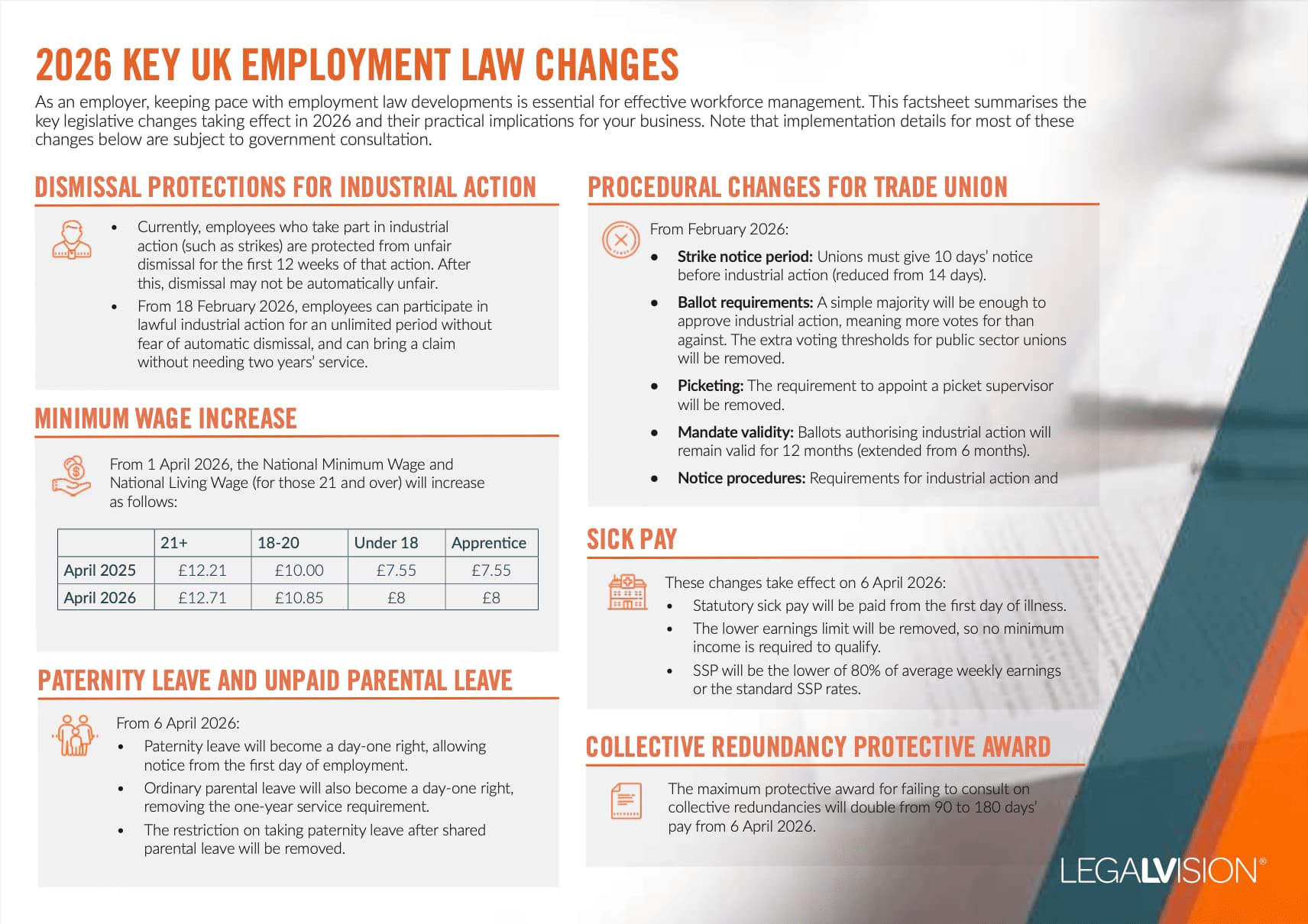
This factsheet summarises the key legislative changes taking effect in 2026 and their practical implications for your business.
How Employment Status Is Determined
The law looks at how the working relationship operates in practice, not at job titles or contract labels. In a dispute, an Employment Tribunal assesses the reality of the arrangement by applying case law and reviewing how the parties actually worked.
Several factors point one way or the other:
- Mutuality of obligation. An obligation to offer and accept work points for employment. The absence of ongoing commitments suggests freelance status.
- Personal service. Employees usually perform the work personally. A genuine independent contractor holds an unfettered right to send a substitute.
- Control. Significant control over how, when and where someone works points to employment. Greater autonomy supports self-employment.
- Financial risk. Employment relationships usually run open-ended, and the organisation carries the financial risk. Independent contractors take on defined projects, invoice for services and accept commercial risk.
In practice, several markers point to employment: you fold the person into the organisation, you supply their equipment, you pay them through payroll, or you give them benefits. The opposite markers point to independent contracting: the person sets their own rates, supplies their own equipment, invoices for work, serves several clients, and keeps the right to delegate or substitute.
What Contracts Should You Use?
Once you decide the status, put in place a contract that matches how the relationship works in practice.
You must give employees a written statement of key terms, including the role, hours, pay and benefits. Engage freelancers under a clear consultancy or contractor agreement that sets out the services, the deliverables, the payment terms, and who carries commercial risk. The parties may negotiate these terms heavily, depending on their bargaining power.
What Extra Safeguards Should You Add When Using Freelancers?
| Safeguard | Why it matters | What to include in the freelancer agreement |
| Intellectual property | Freelancers usually keep ownership of what they create unless the contract transfers it to your business. | Include a clear and valid intellectual property assignment. |
| Liability and termination | You need to manage financial exposure and preserve an exit route if the arrangement stops working. | Set any agreed liability caps, indemnities and termination rights. |
| Confidentiality and data protection | Freelancers may handle personal data, client information, trade secrets or other confidential material. | Include strong confidentiality and data protection obligations. Require compliance with the UK GDPR and the Data Protection Act 2018. If the freelancer processes personal data as a processor, include the mandatory Article 28(3) UK GDPR processing terms. |
| Post-termination restrictions | Restrictions can protect client relationships, staff and confidential information, but only if they are reasonable. | Include restrictions only where they go no further than necessary and are proportionate in scope. |
Key Takeaways
You should assess carefully whether an engagement is employment or freelance contracting in practice, not in name. Getting this right keeps you compliant with your legal obligations and lets you issue the correct contract. The classification turns on the reality of the relationship: mutuality of obligation, personal service, control and financial risk. An employment lawyer can guide you through the details.
LegalVision provides ongoing legal support for businesses through our fixed-fee legal membership. Our experienced employment lawyers help businesses manage contracts, employment law, disputes, intellectual property, and more, with unlimited access to specialist lawyers for a fixed monthly fee. To learn more about LegalVision’s legal membership, call 0808 196 8584 or visit our membership page.
Frequently Asked Questions
Can a freelancer substitute someone else to do the work?
Yes. A genuine freelancer can usually send a substitute to perform the services. Your contract should include a clear substitution right. Without one, you raise the risk that a Tribunal or HMRC treats the freelancer as an employee or worker.
Do I need to give a freelancer a written contract?
You should use a clear consultancy or contractor agreement. It should set out the services, deliverables, payment terms and who carries commercial risk. A written contract that matches the real relationship helps protect your business if HMRC later challenges the status.
Can I review a freelancer’s work without making them look like an employee?
Yes. Focus on deliverables and outcomes, not on how or when they work. Reviewing results reflects a genuine business-to-business relationship. Directing daily methods and hours points towards employment and can put the freelancer’s independent status at risk.
Does IR35 apply if I hire a sole trader directly?
No. IR35 targets freelancers who work through an intermediary, such as a personal service company. If you engage a genuine sole trader directly, IR35 does not apply. You must still assess employment status correctly for tax and employment law.
We appreciate your feedback! Request your free consultation now.


