


Summary
- Before signing, research the other party and confirm the commercial details in the contract match what you negotiated.
- Check each party’s obligations, understand how the contract can be terminated, and note whether it renews automatically.
- Under the law of England and Wales a contract can bind you without a signature, so a solicitor review before signing reduces the risk of disputes.
- This guide explains the key steps to take before signing a business contract for business owners in the UK.
- LegalVision’s business lawyers specialise in advising clients on commercial contracts.
Tips for Businesses
Read every clause before you sign. Check the goods or services description, price, payment terms and contract length match your deal. Confirm your termination rights, note any automatic renewal and diarise the notice period. Run a Companies House check on the other party, and have a solicitor review the contract.


Taking your business beyond the UK opens new markets and revenue streams but how you structure that expansion has long-term consequences for your tax position, legal exposure, and operational efficiency.
Generally, UK businesses entering a new market choose between setting up a subsidiary, opening a branch office or entering a joint venture with a local partner. Whichever route you take, the structure needs to hold up legally and financially in both the UK and in the country you’re entering.
In this guide, we’ll break down how to structure a UK business with an overseas subsidiary across key operational domains: tax, profit allocation, intellectual property, international employment, and cross-border legal compliance.
What is a subsidiary?
A subsidiary is a business entity owned fully or partially by a UK parent company, operating as a separate legal entity with its own liabilities. This separation makes it the preferred choice for businesses looking to isolate risk, enter new markets, manage distinct business lines or position themselves for future mergers and acquisitions.
To get the most out of an overseas subsidiary, the relationship between the parent and the subsidiary needs to be actively structured across:
- Strategic alignment: keeping subsidiary goals in step with the broader corporate direction
- Financial oversight: standardising reporting, auditing practices and accounting compliance
- Operational efficiency: building shared processes and KPIs across the group
- Risk management: identifying jurisdiction-specific risks and putting mitigation plans in place
- Regulatory compliance: monitoring local legal obligations and conducting regular audits
- Communication: establishing clear reporting structures and regular touchpoints between parent and subsidiary
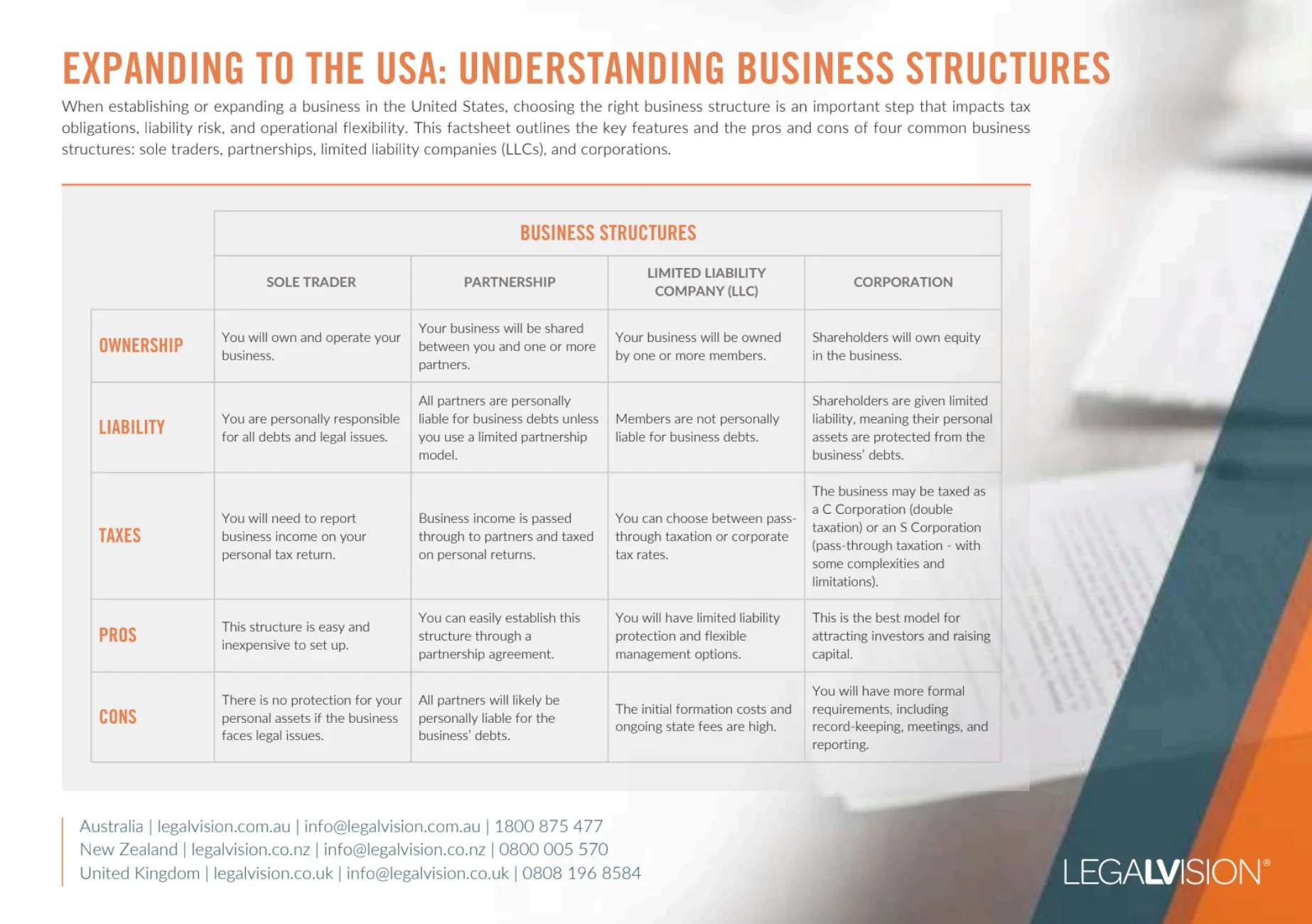
This factsheet outlines the key features and the pros and cons of four common US business
structures: sole traders, partnerships, limited liability companies (LLCs), and corporations.
Tax structure
Tax structuring is one of the crucial decisions you’ll make when setting up an overseas subsidiary. Getting it right will help you protect margin, avoid unnecessary exposure and create a clean framework for how money moves between entities.
There are three areas you need to get right from the outset:
Permanent establishment
How you define your subsidiary’s authority, staffing and operational boundaries determines where its activities are treated as taxable. If staff based overseas are negotiating contracts or exercising operational authority, that activity creates a taxable presence in that foreign jurisdiction.
The greater risk to manage from a UK perspective is Central Management and Control. If the parent company’s directors are making strategic decisions for the overseas entity from the UK, HMRC can treat the subsidiary as UK tax resident and tax its worldwide income accordingly.
Transfer pricing
When money moves between your UK parent and its overseas subsidiary for services, loans, goods or intellectual property, the price can’t be set arbitrarily. Tax authorities on both sides will scrutinise these transactions to make sure profits aren’t being artificially shifted to lower-tax jurisdictions.
Generally, companies follow the arm’s length principle. Transactions between related entities must be priced as if they were between two independent parties. Getting this wrong might expose you to backdated tax adjustments, interest and penalties.
Double taxation treaties
When your business operates across two countries the same income can end up being taxed twice, once where it’s earned and again at home. The UK has treaties with over 100 countries specifically to prevent this.
If you’re setting up a subsidiary in Dubai i, the double taxation treaty generally exempts dividends, interest, royalties and employment income from UK tax for non-residents. For UK residents, the treaty allows you to offset UAE tax paid against your UK liability, so you’re not taxed twice on the same income.
When structuring your company, understand which treaties apply to your situation and factor that in before you incorporate. Residency status, income type and how your entities are structured determine what relief you can claim.
Continue reading this article below the formCall 0808 196 8584 for urgent assistance.
Otherwise, complete this form, and we will contact you on the same business day.
Profit allocation
Deciding where profits sit and how they flow back to the UK parent is one of the more complex structuring decisions you’ll face.
Some countries impose currency controls, require central bank approvals or place restrictions on cross-border transfers. Add withholding taxes and currency conversion costs into the mix and the returns reaching your UK parent can look very different from what the subsidiary earned.
There are three ways to structure this efficiently:
Dividends
The most straightforward route is having your overseas subsidiary distribute profits to the UK parent as dividends. The UK generally exempts these from corporation tax if certain conditions are met but local taxes in the host country may still apply.
Intercompany loans
If the UK parent lends funds to the overseas subsidiary, the subsidiary can make interest payments back to the UK.
Those payments may qualify as deductible expenses for the foreign subsidiary which reduces its local tax liability. The tax authorities will challenge arrangements where the level of debt is disproportionate to the subsidiary’s equity so take the thin capitalisation rules into account.
Tax deferral and foreign exchange
Currency fluctuations affect the value of profits once converted to pounds sterling so timing your repatriation matters.
Some businesses delay transferring profits until exchange rates are favourable or use hedging techniques to manage the risk. Others reinvest foreign earnings locally to take advantage of lower tax rates or local incentives before bringing profits home.
It’s worth noting that some countries impose currency controls, require central bank approvals or restrict cross-border transfers altogether. These friction points combined with withholding taxes and conversion costs can significantly reduce what reaches the UK parent company.
Because the UK’s domestic distribution exemption ensures that dividends hitting your parent company avoid UK Corporation Tax completely, shifts in UK tax rates will not affect your extraction costs. Instead, your financial modelling must focus on the overseas territory: many jurisdictions impose strict currency controls, require central bank clearance, or levy local withholding taxes (WHT) on outgoing cash. Your growth planning must centre on navigating these local foreign extraction hurdles and applying proactive currency hedging rather than domestic tax rate forecasting.
Intellectual property
UK trademarks, patents and copyrights don’t automatically carry over when you expand overseas.
Every market you enter requires separate registration and leaving that too late can allow third parties to acquire similar or identical rights before you do. The only exception is copyright, if the work falls under an international treaty or convention, it may receive automatic protection in signatory countries.
Beyond registration, how you structure IP ownership across your group matters just as much. Where your IP sits determines how it gets licensed, how royalties flow between entities and what your overall tax position looks like.
There are two areas to get right from the outset:
- Ownership and licensing: Contracts with employees, suppliers and partners must clearly define who owns the IP and on what terms. Specify whether licences are exclusive or non-exclusive and make sure agreements reflect local legal standards.
- Where IP sits in your structure: This is the decision with the biggest commercial and tax implications.
Employment
Hiring locally is often the most practical way to build presence in a new market, but it introduces a layer of compliance that catches many UK businesses off guard.
There are three areas to consider from the outset:
Contracts and statutory entitlements
Employment contracts must meet minimum legal thresholds and be written in the local language. Leave entitlements and collective bargaining obligations vary significantly by jurisdiction and can’t be modelled on UK standards.
Employer registrations and contributions
Most countries require businesses to register for social security and contribute to local pension and healthcare schemes. Termination and redundancy processes are heavily regulated with mandatory consultation periods, notice requirements and statutory compensation that can be significantly higher than UK equivalents.
Secondments and permanent establishment risk
If you’re moving UK employees into the overseas subsidiary rather than hiring locally, you need to assess visa and work permit requirements, tax residency implications and the risk of creating a permanent establishment through the individual’s activities before the move.
Whether you hire directly, use an employer of record or second existing staff, the right choice depends on how permanent your presence in that market is intended to be.
Dispute resolution
Legal systems vary significantly across jurisdictions in terms of reliability, independence and procedural efficiency. This needs to be factored into your contracts before you sign anything.
Before you sign anything:
- Every contract should specify which country’s law applies and where disputes will be resolved. Arbitration is the stronger option where local court systems are slow or lack independence.
- Ensure arbitration clauses refer to an internationally recognised venue like the London Court of International Arbitration (LCIA).
Even with the right arbitration clause in place, recovering a judgment becomes significantly harder where no reciprocal enforcement agreement exists between countries. A lawyer experienced in cross-border structuring can make sure your agreements hold up in the jurisdictions that matter to you.
LegalVision provides ongoing legal support for businesses through our fixed-fee legal membership. Our experienced corporate lawyers help businesses manage contracts, employment law, disputes, intellectual property, and more, with unlimited access to specialist lawyers for a fixed monthly fee. To learn more about LegalVision’s legal membership, call 0808 196 8584 or visit our membership page.
We appreciate your feedback! Request your free consultation now.


