


Summary
- Registering a trade mark with the UK Intellectual Property Office grants legal exclusivity and the right to use the ® symbol, whereas ™ and ℠ are unregistered symbols that offer no legal protection.
- If another business uses your registered trade mark without consent, you may pursue an out-of-court settlement or formal legal proceedings for infringement.
- The ® symbol may only be used in jurisdictions where the trade mark has been formally registered.
- This article is a plain-English guide to trade mark symbols and IP protection for business owners operating in England and Wales, authored by LegalVision, a commercial law firm.
- LegalVision specialises in advising clients on intellectual property law and trade mark registration.
Tips for Businesses
Use ® only after registering your trade mark with the Intellectual Property Office. Use ™ to signal brand identity before registration. Register separately in each jurisdiction where you trade. If you suspect infringement, consider mediation before litigation to reduce costs and publicity.


If you run a business in England and Wales it is important to consider protecting your business’s intellectual property. One way of doing so is by registering your business’s trade mark. Registration has several benefits, and you can do this through the UK Intellectual Property Office. This article will discuss different types of IP protection available for you. It will also discuss what the ® and various other symbols mean.
What is the ® Symbol and Why Should You Use It?
The ® symbol indicates that the word, phrase, logo, or an adjacent symbol is a registered trade mark. It must be specifically registered for the product or service it represents. Further, the symbol can only be used where a trade mark has been registered with the Intellectual Property Office. It can also only be used next to a trade mark in the country it is registered in.
For example, to use the ® symbol on a business logo in England, you must register your trade mark with the Intellectual Property Office. However, if you then expanded into another region, for example, the EU, you would not be able to use the ® symbol next to your logo until you had registered your trade mark in that region.
Other Commonly Used Symbols
If you are familiar with seeing the ® symbol, you have probably also seen a few others and wondered what the differences are. For example, you can use the ™ symbol next to logos. The difference between ™ and ® however is that you do not have to register your trade mark in order to use the ™ symbol. Therefore, if you see the ™ symbol next to a business logo, it could mean that its user has not yet registered it. This means it is not necessarily exclusive in character as another business could challenge this, or seek to register it themselves.
Another widely used symbol is the service mark: ℠. This symbol is different from ™ and ®, as it only refers to services rather than products or goods. It is also unregistered in character, similar to ™. The ℠ symbol is most commonly used with banking or legal services and does not guarantee exclusivity, contrastingly to ®.
Continue reading this article below the formCall 0808 196 8584 for urgent assistance.
Otherwise, complete this form, and we will contact you on the same business day.
How to Choose the Correct Symbol
The ® signifies legal ownership of the trade mark. You should use it if you have registered your mark. The ® symbol next to your trade mark identifies that you have registered it with the Intellectual Property Office. This can help deter any competitors from trying to copy it in any way.
If you have an unregistered trade mark, you can use the ™ symbol. This is particularly useful if you are trying to build up a reputation within the public domain. It can help you portray a strong brand identity and can suggest to competitors that your logo is a symbol of your business identity.
If your business mainly provides services, you can make use of the ℠ symbol. Like the ™ symbol, it does not provide you with any legal protection or signify exclusivity. However, you may wish to use it in order to show you are a service provider and to add an element of stronger branding to your business.
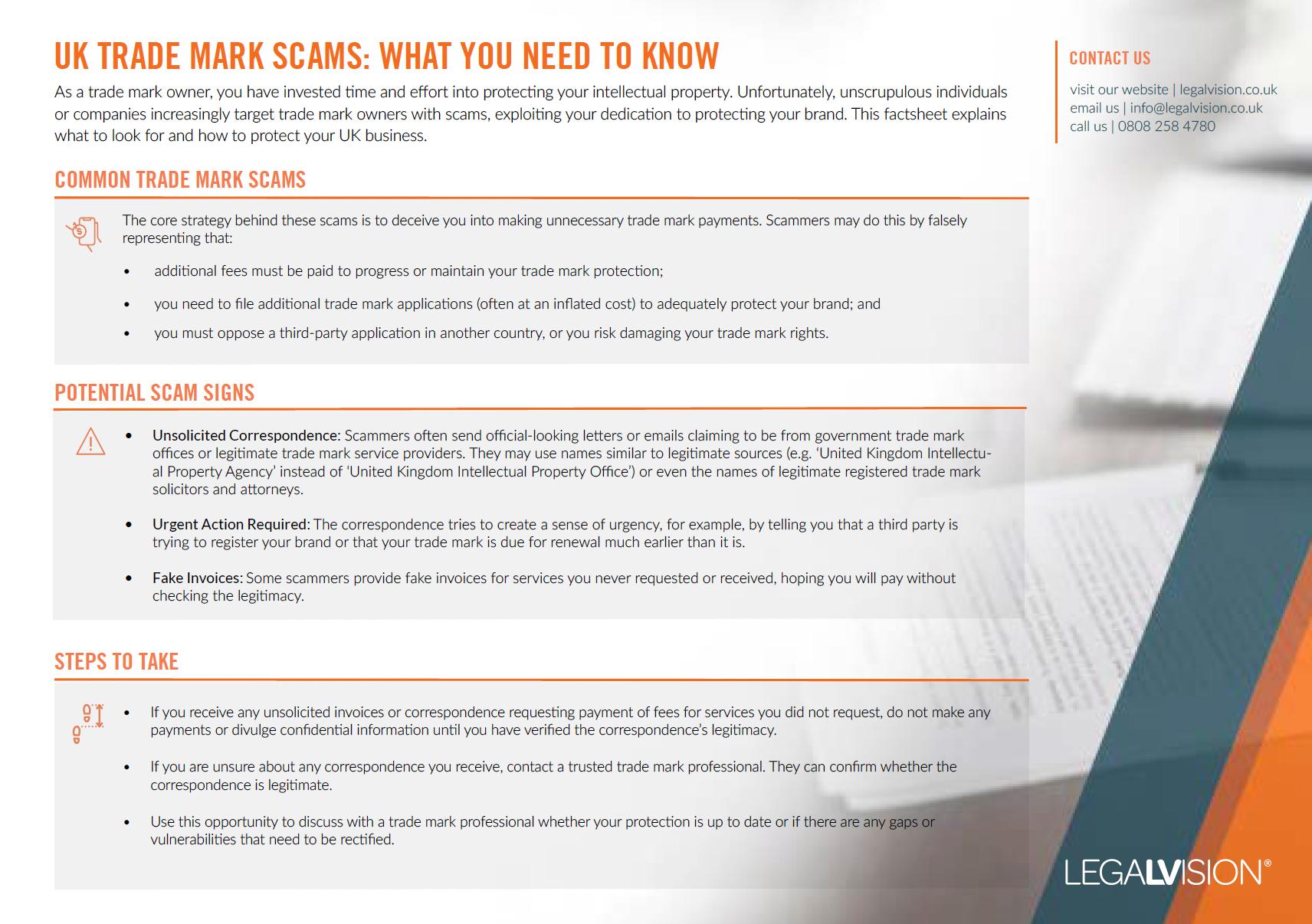
Increasingly, unscrupulous individuals or companies target trade mark owners with scams, exploiting your dedication to protecting your brand. This factsheet explains what to look for and how to protect your UK business.
How Long Does Trade Mark Registration Last?
Once you register your trade mark with the Intellectual Property Office, it lasts for ten years. You can renew it every ten years after that, for as long as you need it.
It is worth knowing that your trade mark can be removed from the register if you do not use it. If another business can show that you have not used your trade mark for five continuous years, they can apply to have it cancelled. This is called a “non-use” cancellation.
To keep your trade mark protected, make sure you actively use it in connection with the goods or services it covers. Keep records of how and when you use it. This could include invoices, marketing materials, or product packaging. Good record-keeping makes it much easier to defend your trade mark if someone challenges it.
Dealing With Trade Mark Infringement
If you have a registered trade mark with the Intellectual Property Office and you believe another business is using your trade mark without consent, or something substantially similar, you may have a legal claim for trade mark infringement. You ultimately have two options if this happens:
1. Out-of-court Settlement
One option you could pursue is to opt for an out-of-court settlement. This could potentially include compensation for any financial loss you have sustained as a result of the infringement. You would also not have to go to court, and this would save you the publicity and costs of litigation. A professional mediator may also semi-formally facilitate your matter through mediation. This is one form of alternative dispute resolution. Some other forms of alternative dispute resolution include informal negotiations and arbitration.
2. Legal Proceedings
Trade mark registration provides you with exclusivity, so if there has been a violation of this right by another business or individual, you have the right to take another person to court for infringement. This could also result in financial compensation (that is, damages) or a costs order.
It is important that you seek legal advice before pursuing alternative dispute resolution or litigation. This way you can best weigh up your options and come to an informed decision.
Key Takeaways
The ® symbol is used to identify trade marks that you have formally registered with the Intellectual Property Office. Trade marks hold exclusivity rights and their owners benefit from being able to challenge another business or individual if they attempt to copy or use the trade mark. If another business violates your exclusivity in this way, you may be able to bring legal proceedings for infringement or you could potentially reach an out-of-court settlement.
LegalVision provides ongoing legal support for businesses through our fixed-fee legal membership. Our experienced intellectual property lawyers help businesses manage contracts, employment law, disputes, intellectual property, and more, with unlimited access to specialist lawyers for a fixed monthly fee. To learn more about LegalVision’s legal membership, call 0808 196 8584 or visit our membership page.
Frequently Asked Questions
What is the difference between ® and ™?
® is used for trade marks that have been registered with the Intellectual Property Office, whereas ™ is only used for unregistered trade marks. If your trade mark is unregistered, you are not permitted to use the ® symbol.
When can I use the ™ symbol?
The ™ symbol can be used without restriction, as it is solely for unregistered trade marks. Therefore, if you have a registered trade mark we recommend using the ® symbol, as this shows other competitors that your trade mark is exclusive to your business.
Can I register a trade mark in multiple regions?
Yes, you must register separately in each region to use the ® symbol there.
Does ™ offer legal protection?
No, ™ provides no legal exclusivity or protection.
We appreciate your feedback! Request your free consultation now.


