


Comfort:
Good morning all, and welcome to our webinar on 2025 key UK employment law changes. My name is Comfort Kang, and I’m a Practice Leader in our Employment Law and Health and Safety at Work team.
Before we begin today, a couple of quick housekeeping items:
You will receive the recording and slides of this webinar via email after the session. Please do submit your questions in the Q&A box, and we’ll answer them at the end. Also, please complete the feedback survey after the webinar – we truly appreciate it.
For the next 48 hours, you will be eligible for a free consultation with LegalVision to discuss how we can help you and your business. Please provide your contact details in the survey at the end of this webinar if you’d like to take advantage of the complimentary consultation.
Today, we’ll be discussing the following topics:
- Changes to the minimum wage rates, including the National Minimum Wage and National Living Wage.
- Changes to National Insurance contributions, including the secondary threshold and rate.
- Neonatal Care Leave and Pay.
- The Employment Rights Bill of 2024.
- Finally, we’ll provide some of our recommendations and answer any questions you may have following the webinar.
Before we dive in, we have a quick poll for you to complete, which is going to pop up now. The question is: What is your biggest challenge in managing employment law changes in your organisation? It’s a multiple-choice poll with the following options:
- Adapting to changes in statutory pay
- Preparing for proposed reforms
- Managing the removal of the two-year qualifying period
- Understanding the practical steps needed to stay compliant
- Not sure yet, just looking to get informed about changes
We’ll give you a minute to respond to the poll before we get started.
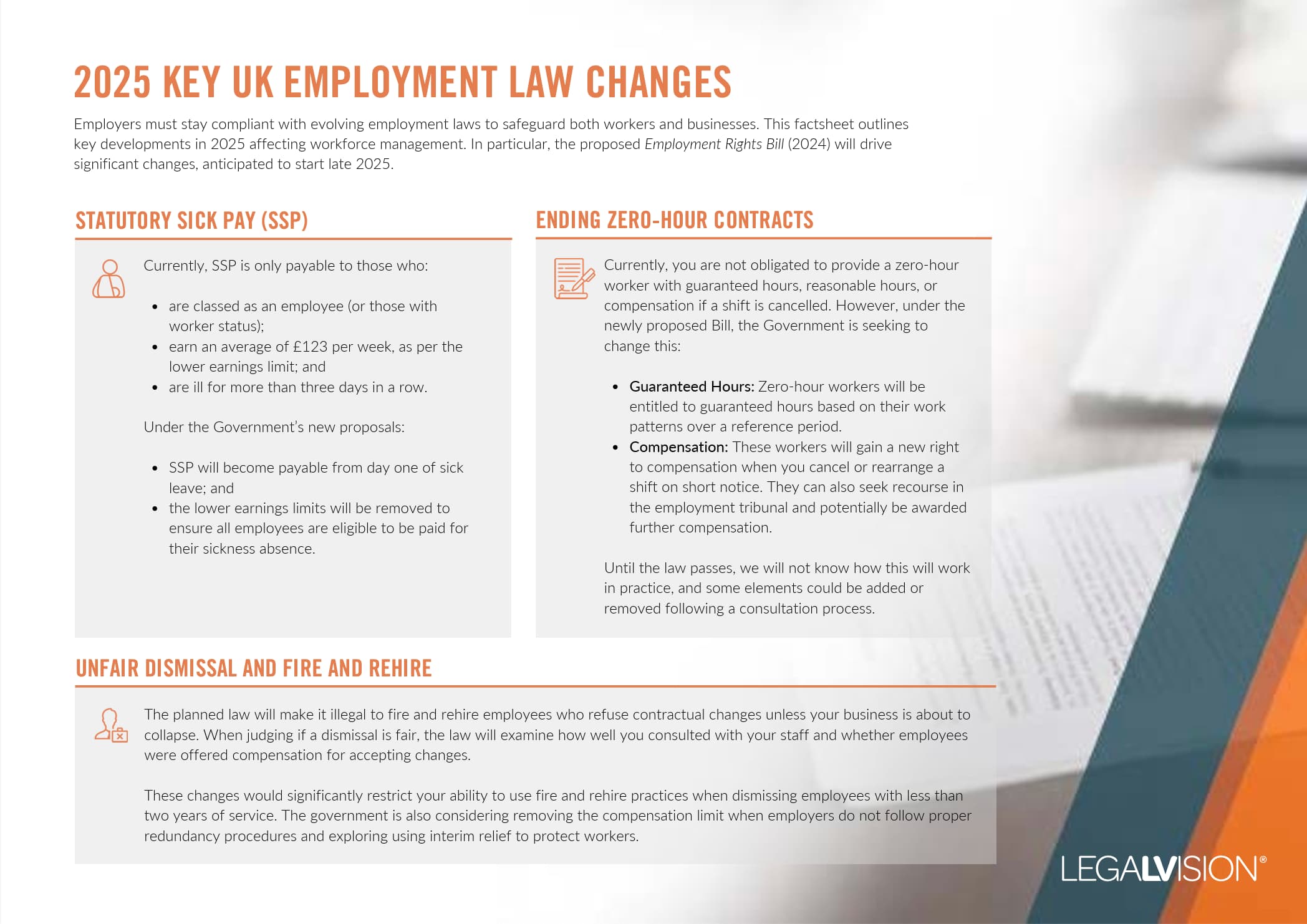
This factsheet outlines key developments in 2025 affecting workforce management.
Poll Results:
Thanks for taking the time to answer that. Most of you are looking to understand the practical steps needed to stay compliant, as well as those who are not sure yet and are simply looking to be informed about the changes happening. Thanks for your responses – we hope you get the answers you need in this webinar. If you have any additional questions that we don’t get to cover, please take advantage of the free consultation we’re offering in the next 48 hours.
Agenda Item 1: Minimum Wage Changes
Comfort:
Let’s get into it. First, we’ll touch on minimum wage changes.
Regarding the National Minimum Wage and National Living Wage, you may know that entitlement to each is quite different. To be entitled to the National Minimum Wage, individuals must be around the school-leaving age, typically around their 16th birthday, though the exact date differs slightly depending on whether your employee lives in England, Wales, Scotland, or Northern Ireland.
To be entitled to the National Living Wage, employees must be at least 21 years old.
For those 21 and over, the current rate is £14.40, which will rise to £12.21 on 1st April. For those aged 18-20, the rate will increase from £8.60 per hour to £10 per hour. For employees under 18 or apprentices, the rate will rise from £6.40 to £7.55 per hour.
If you have employees or workers in your business who are paid exactly the current national minimum wage, ensure you make the relevant changes to their hourly rate starting 1st April. You can notify them of this change by simply sending a letter to amend the terms of their employment. No one will complain about a salary increase, but it’s always good practice to keep employees informed.
Agenda Item 2: National Insurance Contributions
Comfort:
Next, let’s discuss changes to National Insurance contributions.
From 6th April this year, the employer’s secondary class one National Insurance contributions rate will increase from 13.8% to 15%. Additionally, the secondary threshold will be reduced. Currently, the earnings above which your company becomes liable to pay secondary class one National Insurance contributions are £9,100 per year. From 6th April 2025 until 5th April 2028, the threshold will drop to £5,000 annually.
After April 2028, this threshold will continue to rise in line with the Consumer Prices Index (CPI).
This change will affect around 1.2 million employers, with 940,000 employers seeing an increase in their National Insurance contributions liability. On average, the cost per employee will rise by around £900 per year. However, this change will not affect apprentices or employees under the age of 21.
Agenda Item 3: Neonatal Care Leave and Pay
Comfort:
Moving on to neonatal care:
Neonatal care refers to special care given to babies who are sick or born prematurely. The government has introduced legislation for Neonatal Care Leave and Pay, which, subject to parliamentary approval, will take effect from 6th April.
This new entitlement applies to parents of babies who are admitted to neonatal care within the first 28 days of their life or have a continuous stay in hospital for 7 full days or more.
Parents will be entitled to up to 12 weeks of leave, in addition to any other leave such as maternity or paternity leave. Statutory neonatal care pay will also be available for those who meet continuity of service and minimum earnings requirements.
We recommend that employers start putting in place a Neonatal Care Leave and Pay policy and ensure employees are aware of these upcoming changes.
Agenda Item 4: The Employment Rights Bill
Comfort:
Next, we’ll touch on the Employment Rights Bill.
This is a comprehensive bill, which is set to introduce significant changes to employment rights, including new protections for employees. While the bill hasn’t been passed yet, we’re discussing the proposed changes so you can prepare for its potential impact.
The key proposals include:
- Statutory Sick Pay (SSP) will become payable from day one of sickness absence, without a lower earnings limit.
- Zero-hour workers will be entitled to guaranteed hours based on their work patterns over a reference period.
- There will be rights to compensation for short-notice shift cancellations.
- The bill will make unfair dismissal protection a day-one right, meaning employees will be protected from unfair dismissal from the start of their employment.
These changes will likely come into effect late in 2025 or early in 2026, and we will keep you updated on any developments.
Comfort:
Now, let’s move on to our recommendations:
For the changes that are set to come into effect in April, such as Neonatal Care Leave and Pay, we recommend that you update your staff handbook and internal policies now to prepare for these changes. It’s also a good time to involve your employees and keep them informed.
For other changes, such as those under the Employment Rights Bill, you can wait until the bill becomes law before making any updates.
Comfort:
That concludes the main part of our webinar. We also have a publication available on the key UK employment law changes in 2025, which you may find useful.
Lastly, I’d like to mention an upcoming event on buying a tech or online business – what you should know. This will take place on Tuesday, 18th February at 11 am. You can register via our website.
Q&A Section
Comfort:
Now, I’ll move on to answering your questions. The first question is: Should we update our policy now to reflect the proposed changes under the bill?
As mentioned earlier, you can wait until the bill becomes law to make those changes. However, for the changes coming into effect from April, such as Neonatal Care Leave, it’s a good idea to start updating your staff policies and creating the new policies now. Please do seek legal advice to ensure your policies reflect both the statutory position and your business intentions.
Comfort:
The second question is: What is the best practice from an HR perspective in dealing with these changes?
The best practice is usually to update the policy or create new policies where necessary. You can use that opportunity to review your entire handbook and policies overall. We recommend looking at your policies at least once a year to ensure they align with changes in the law and your business intentions. You should also notify your employees once changes are made to the policies by either sharing them or letting them know where to find them.
Comfort:
The third question is on proposed changes to probationary periods, which we touched on earlier. As mentioned, the current position regarding probationary periods is that it’s a commercial decision for businesses to decide the duration and whether to include a probationary period in the employee’s contract.
However, for the proposed changes, we are yet to see how long the statutory probationary period will be, and we’ll need to wait for further clarification from the government.
Comfort:
The next question is: Is this webinar recorded?
Yes, it is recorded, and we will send the recording to you via email.
Comfort:
Thank you all for your questions. That’s all the time we have for today. If I didn’t have a chance to answer your question, please submit your details in the survey at the end, and I’ll be able to answer your question in more detail. Our team is also available to assist with your questions and provide additional support.
Comfort:
Before we wrap up, I just want to mention again that, while this is a free webinar, we do value your feedback. Please take just a few seconds to answer the survey at the end – it shouldn’t take more than 30 seconds.
On behalf of myself and the team, thank you so much for joining us today. Have a great day, and goodbye!
We appreciate your feedback – your submission has been successfully received.


