


Summary
- Trade mark scams in the UK commonly take the form of fraudulent publication invoices and fake conflict emails designed to mimic official correspondence from the UK Intellectual Property Office (UK IPO).
- Legitimate trade mark fees are payable only to the UK IPO or an authorised trade mark attorney registered with the Solicitors Regulation Authority.
- Businesses should verify all unexpected trade mark correspondence before making any payment or disclosing information about their trade mark use.
- This article is a plain-English guide to UK trade mark scams for business owners operating under the jurisdiction of the UK IPO.
- The content is produced by LegalVision, a commercial law firm that specialises in advising clients on intellectual property and trade mark matters.
Tips for Businesses
Check all trade mark correspondence against the UK IPO’s official scam list before responding. Confirm that any fees are payable directly to the UK IPO or your appointed attorney. Do not disclose trade mark use or trading history to unknown parties. Contact the IPO on 0300 300 2000 to verify suspicious communications.


A trade mark scam is a fraudulent scheme that targets businesses and individuals by exploiting the trade mark registration process under the jurisdiction of the United Kingdom Intellectual Property Office (UK IPO). The UK IPO, established under the Trade Marks Act 1994, is the sole official body responsible for registering trade marks and publishing applications in the UK Trade Marks Journal. Fraudulent operators monitor publicly available IPO records to send unsolicited invoices and conflict notices designed to mimic official correspondence. Recognising that legitimate trade mark fees are payable only to the UK IPO or an appointed attorney registered with the Solicitors Regulation Authority is the first line of defence against these schemes. This article explains the most common trade mark scams targeting UK businesses, how to identify them and the steps you can take to protect yourself.
Protecting Yourself from Trade Mark Scams
Trade mark scams rely on businesses acting before verifying unexpected correspondence. Before making any payment or responding to trade mark-related communications, you should:
- verify the sender is the UK IPO or your appointed trade mark attorney;
- legitimate trade mark fees are only payable to the UK IPO or your authorised representative;
- never pay unsolicited invoices for publication or registration services; and
- not respond to emails claiming an urgent trade mark conflict without independently verifying the sender.
Publication Register Scams
One of the most prevalent trade mark scams involves fraudulent invoices for publication services. Shortly after filing your trade mark application with the UK, you may receive official-looking correspondence by post from companies with names such as “OMPS” (Official Mark Publication Service), “TPS” (Trademark Publication Service) or “VPS” (Verification Publication Service).
These letters typically arrive within weeks of your application and appear legitimate. They often feature formal letterheads, reference your specific trade mark details and request payment for publishing your trade mark in an “official register” or “international database”. The invoices usually demand several hundreds of pounds, with payment deadlines creating a sense of urgency.
How the Scam Works
These companies monitor publicly available trade mark applications filed with the IPO. Once your application appears in the official register, they extract your details and send invoices for services you never requested. The correspondence is deliberately designed to resemble official IPO communications, using similar fonts, layouts and formal language.
The “services” offered are entirely worthless. While these companies may technically publish your trade mark in their own private registers, these publications serve no legal purpose and provide no additional protection or benefit. Your trade mark is already published in the official UK IPO register as part of the standard application process at no extra cost.
Warning Signs
Several red flags can help you identify these scams:
- the invoice comes from a company you did not instruct or recognise;
- payment is requested for “publication” or “registration” in a non-governmental register;
- the company name sounds official, but it is not the UK Intellectual Property Office;
- the invoice arrives shortly after filing your application; or
- payment deadlines are unusually tight, creating artificial urgency.
Call 0808 196 8584 for urgent assistance.
Otherwise, complete this form, and we will contact you on the same business day.
Brand Conflict Email Scams
A second common scam involves emails claiming urgent conflicts with your trade mark. You receive a message purportedly from a solicitor or trade mark attorney stating they represent a client who wishes to file an identical or similar trade mark to yours. The email typically suggests that their client has priority or that your trade mark may face opposition unless you take immediate action.
How the Scam Works
These emails exploit business owners’ fears about losing their trade mark rights. The sender claims to be conducting due diligence for a client and has discovered your existing trade mark. They may request that you:
- confirm whether you are still actively using your trade mark;
- provide evidence of use or trading history;
- pay a fee to “reserve” your rights or prevent the conflicting application;
- transfer or sell your trade mark rights; or
- engage their services to “protect” your trade mark.
Warning Signs
Legitimate trade mark conflicts are handled through formal IPO procedures, not unsolicited emails. Be suspicious if:
- the email creates artificial urgency with tight deadlines;
- the sender requests payment to avoid a conflict;
- you are asked to confirm use of your trade mark to an unknown party;
- the sender’s email address does not match their claimed law firm;
- the correspondence lacks specific details about the alleged conflicting application; or
- you are pressured to make immediate decisions without time for proper legal advice.
Protecting Your Business: Verify All Correspondence
Before responding to any trade mark-related communication, verify the sender’s legitimacy. The UK IPO maintains a list of known scam companies on its website. Check whether the sender appears on this list and compare any correspondence against official IPO communications.
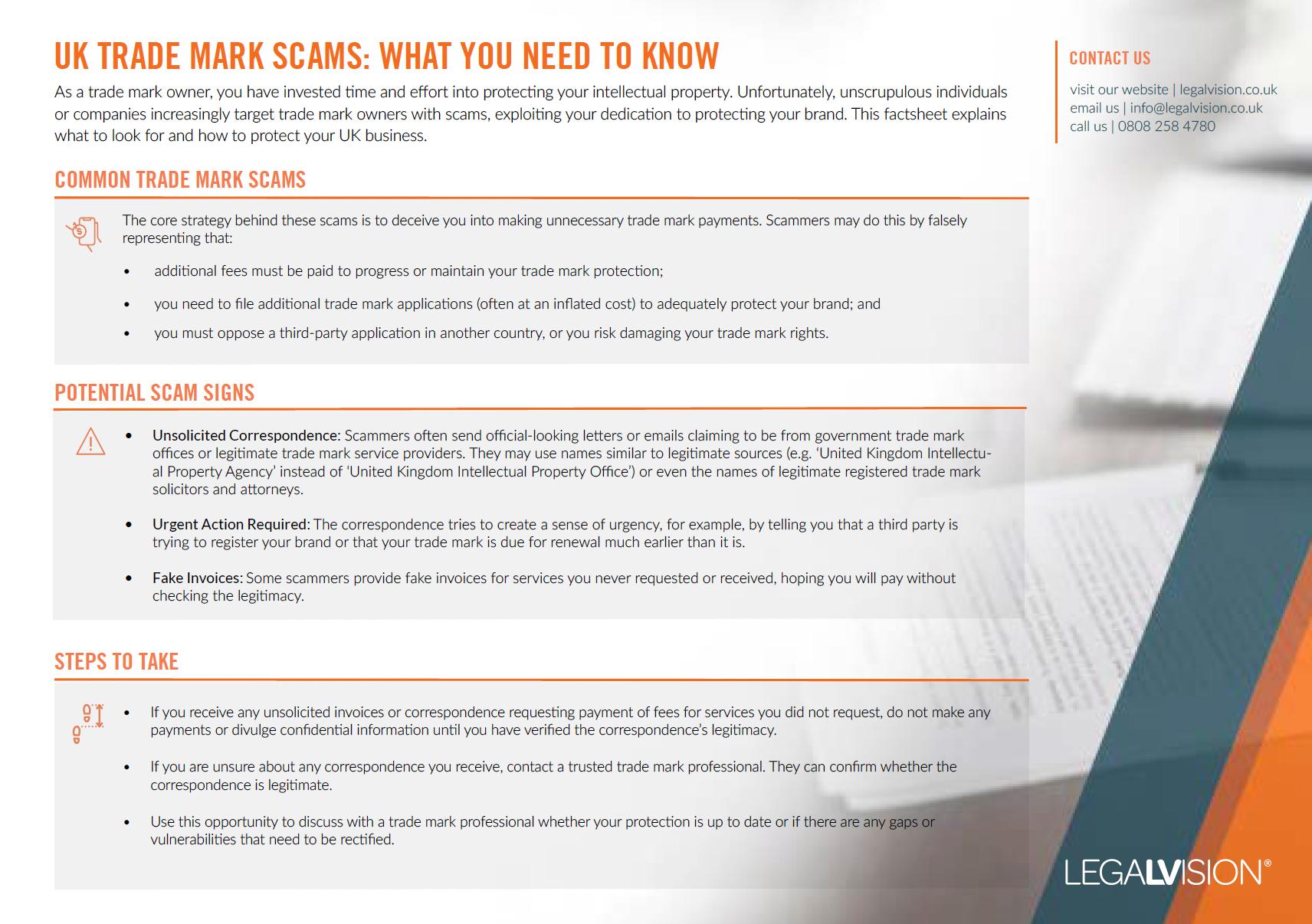
Increasingly, unscrupulous individuals or companies target trade mark owners with scams, exploiting your dedication to protecting your brand. This factsheet explains what to look for and how to protect your UK business.
Key Takeaways
Trade mark scams targeting UK businesses have become increasingly sophisticated, with fraudulent publication invoices and fake conflict emails being the most common schemes. These scams exploit the complexity of trade mark procedures and business owners’ fears about losing brand protection. Always verify correspondence before making payments. Remember that legitimate trade mark fees are only payable to the UK IPO or your appointed attorney, and consult professional advisors when you receive unexpected trade mark-related demands. By recognising warning signs and taking a cautious approach, you can protect your business from these fraudulent schemes while ensuring your trade mark application proceeds smoothly.
If you need help verifying trade mark correspondence or protecting your brand, LegalVision provides ongoing legal support for all businesses through our fixed-fee legal membership. Our experienced intellectual property lawyers help businesses manage contracts, employment law, disputes, intellectual property, and more, with unlimited access to specialist lawyers for a fixed monthly fee. To learn more about LegalVision’s legal membership, call 0808 196 8584 or visit our membership page.
Frequently Asked Questions
What are publication register scams and how do they work?
Fraudulent companies monitor publicly available IPO trade mark applications and send official-looking invoices requesting payment to publish your mark in a private register. These publications serve no legal purpose. Your trade mark is already published in the official UK IPO register as part of the standard application process at no extra cost.
How can I verify if correspondence is genuinely from the UK IPO?
Check that emails come from an @ipo.gov.uk address and letters include the official IPO address in Newport, South Wales. The IPO website lists all official fees and contact details. If in doubt, telephone the IPO directly on 0300 300 2000 to verify whether they sent the correspondence. If your trade mark application was filed by a law firm, you can also send them a copy of the correspondence to verify. Never use contact details provided in suspicious letters.
Will the IPO contact me about my trade mark application?
Yes, the IPO will contact you regarding examination reports, opposition proceedings or other official matters relating to your application. However, they will never request payment through third-party companies or ask you to pay for publication in private registers. All official correspondence includes your application number and comes through formal channels.
What should I do if I receive an email about a trade mark conflict?
Do not respond immediately or provide any information. First, verify the sender’s identity by searching for their law firm online and checking that they are registered with the Solicitors Regulation Authority. Contact them directly using details from their official website, not the email. Consult your own trade mark attorney before taking any action.
We appreciate your feedback! Request your free consultation now.


