


Summary
- A model release form is a written agreement giving a business permission to use an identifiable person’s image for advertising or promotional purposes.
- Obtaining a signed release reduces the risk of disputes but does not replace obligations under UK GDPR, privacy law, or consumer protection legislation.
- Businesses must also confirm they hold copyright in the photograph, or have a licence from the copyright owner, before using it.
- This article is a plain-English guide to model release forms for business owners operating in England and Wales, covering key legal obligations around image use in advertising and marketing.
- The content has been prepared by LegalVision’s business lawyers, a commercial law firm that specialises in advising clients on commercial contracts, data protection, and intellectual property.
Tips for Businesses
Before using a photo of an identifiable person, confirm you have a signed release, a valid legal basis under UK GDPR, a privacy notice in place, and the right to use the image under copyright law. For photos of children or where consent may be withdrawn, seek legal advice early.

Many businesses use photos of people in their marketing and promotional materials. A model release, also called an image release, is a written agreement that gives a business permission to use a person’s photo for agreed purposes. This article explains how model releases work in the UK, when you need one, and the common issues to watch out for.
How Does a Model Release Form Work?
A model or image release form is a document where a person gives a business permission to use a photo of them for certain purposes. Businesses usually write this as a simple letter that explains the terms for using the photo.
A business will usually ask someone to sign a model release form before using a photograph of an identifiable person for advertising or promotional purposes. This is commonly needed when the photo is of a member of the public and will be published in places such as:
- in brochures;
- in marketing materials;
- in promotional campaigns;
- in online content;
- in presentations; and/or
- on a website.
When Does a Business Need a Model Release?
Model release forms are usually needed when a photo clearly shows someone who can be identified, either alone or in a small group. The document sets out what the business is allowed to do with the photo and for what purposes.
Businesses will often need a model release when they want to use a photo of an identifiable person who is not a celebrity or a professional model. A release is usually needed when the person can be clearly recognised, rather than when they simply appear in the background of a crowd.
The release confirms that the person has given permission for the business to use their image and sets out how the photo can be used. Having a written agreement helps avoid misunderstandings and reduces the risk of disputes about using the photo in advertising or other promotional materials.
Continue reading this article below the formCall 0808 196 8584 for urgent assistance.
Otherwise, complete this form, and we will contact you on the same business day.
Important Legal Issues to Consider
Using photographs of identifiable people for advertising or promotional purposes can raise several legal issues, including the following:
1. Privacy Issues
England and Wales does not have a specific law for privacy or image rights. However, people may have legal protection if someone uses a photo where they can be identified without permission.
Courts have developed privacy law in this area through case law (and the law continues to change). For this reason, businesses generally obtain consent before they use a photograph of an identifiable individual for publicity or promotional purposes.
2. Data Protection Issues
If a photo shows a living person who can be identified, it may be treated as personal data under the UK GDPR and the Data Protection Act 2018.
However, consent must meet strict legal requirements. It must be given freely, be specific and informed, and be clearly expressed. The person must also be able to withdraw their consent at any time.
Using someone’s photo also means you must follow the wider rules under data protection law. These include:
- using personal data fairly and lawfully;
- only using it for the purpose you explained;
- collecting only what you need;
- keeping it accurate and secure; and
- being able to show that you comply with the law.
You should also be clear about how you will use the person’s image. In most cases, this means providing a privacy notice that explains, in plain language, how their personal data will be collected, used and stored.
3. Consumer Law Issues
When a business asks a member of the public to sign a model release form, that person may be treated as a consumer under the law. This means the agreement must also comply with consumer protection laws, including the Consumer Rights Act 2015.
4. Intellectual Property Issues
A model release form does not usually deal with copyright in the photograph. In most cases, the photographer owns the copyright, unless the photo was taken as part of their employment or the rights have been transferred to someone else.
Before using a photo, a business should make sure it owns the copyright or has permission from the copyright owner. If the person signing the model release also owns the copyright, the business will usually need both a copyright licence and permission to use their image.
Risk Issues to Understand and Taking Legal Advice
Some situations need extra care. For example, using photos of children can raise additional privacy and data protection issues.
If your business relies on a person’s consent under the UK GDPR, remember that they can withdraw that consent at any time. If they do, you may have to stop using their photo for the purposes they originally agreed to. This can create problems if the image has already been used in advertising or other marketing.
If you plan to use photos of children, rely on consent, or are unsure about the legal position, it is a good idea to get legal advice.
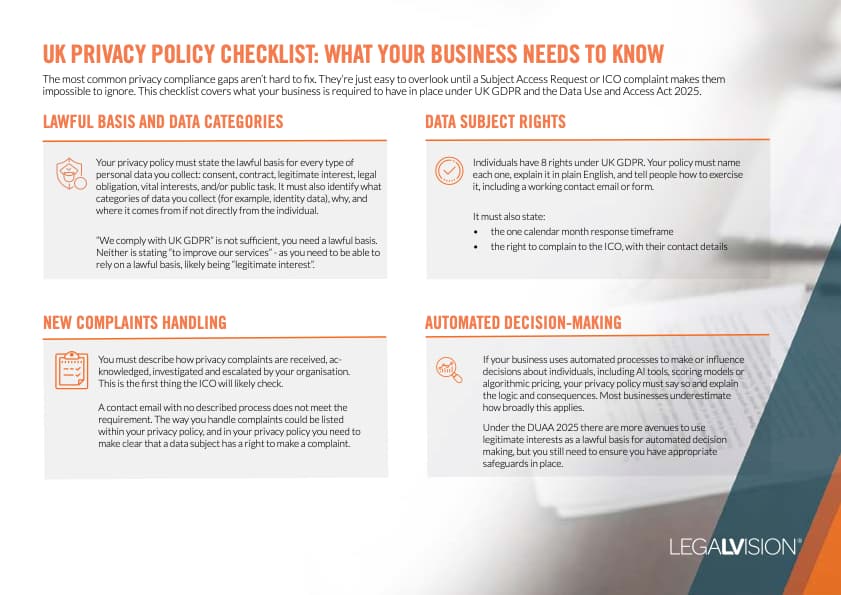
Download the free checklist to see where your business stands under UK GDPR and the Data Use and Access Act 2025.
Key Takeaways
A model release form is a written agreement that gives a business permission to use a photo of an identifiable person for advertising or promotional purposes. Businesses often use these forms when they want to include photos of members of the public in their marketing materials. A clear written agreement helps record the person’s permission and reduces the risk of disputes. However, a model release is only part of the picture. Privacy, data protection, consumer and intellectual property laws can all affect how a photo can be used. Therefore, it is important to consider these rules before using someone’s image.
LegalVision provides ongoing legal support for businesses through our fixed-fee legal membership. Our experienced data, privacy and IT lawyers help businesses manage contracts, employment law, disputes, intellectual property, and more, with unlimited access to specialist lawyers for a fixed monthly fee. To learn more about LegalVision’s legal membership, call 0808 196 8584 or visit our membership page.
Frequently Asked Questions
What is a model release form?
A model release form is a document where someone gives a business permission to use a photo of them.
When is a model release form needed?
A model release form is usually needed when a business wants to use a photo of someone who can be identified. For example, they may wish to use the relevant image in their advertising or marketing content.
Can someone withdraw consent after signing a model release?
Yes. Under UK GDPR, a person can withdraw consent at any time. If they do, the business may need to stop using their image. This can cause complications if the photo is already in active use.
Does a model release form satisfy data protection obligations?
No. A model release records consent but does not replace compliance with data protection law. Businesses must still follow UK GDPR requirements, including providing a privacy notice and handling personal data lawfully, fairly, and securely.
We appreciate your feedback! Request your free consultation now.


