


Summary
- A UK patent grants up to 20 years of protection for new, inventive, and industrially applicable inventions, subject to annual renewal.
- Patents cannot be granted for discoveries, mathematical methods, artistic works, or ways of presenting information.
- Medicinal and plant-related inventions may receive an additional five years of protection via a supplementary protection certificate.
- This article is a plain-English guide to UK patent law for business owners considering protecting a new invention.
- The content has been produced by LegalVision, a commercial law firm that specialises in advising clients on intellectual property matters.
Tips for Businesses
File your patent application before publicly disclosing your invention, as prior disclosure can invalidate your claim. If you operate across multiple countries, file separate applications in each jurisdiction within 12 months. Consider whether the cost and renewal fees are commercially justified before proceeding.


If you are a business owner in the UK and are considering patenting a new invention, you must understand the restrictions regarding applications and how long the protection lasts. Without this knowledge, you could end up with a costly and lengthy application process that was completely unnecessary. This article will discuss the process of patenting products, the requirements you must meet and how long the protections last.
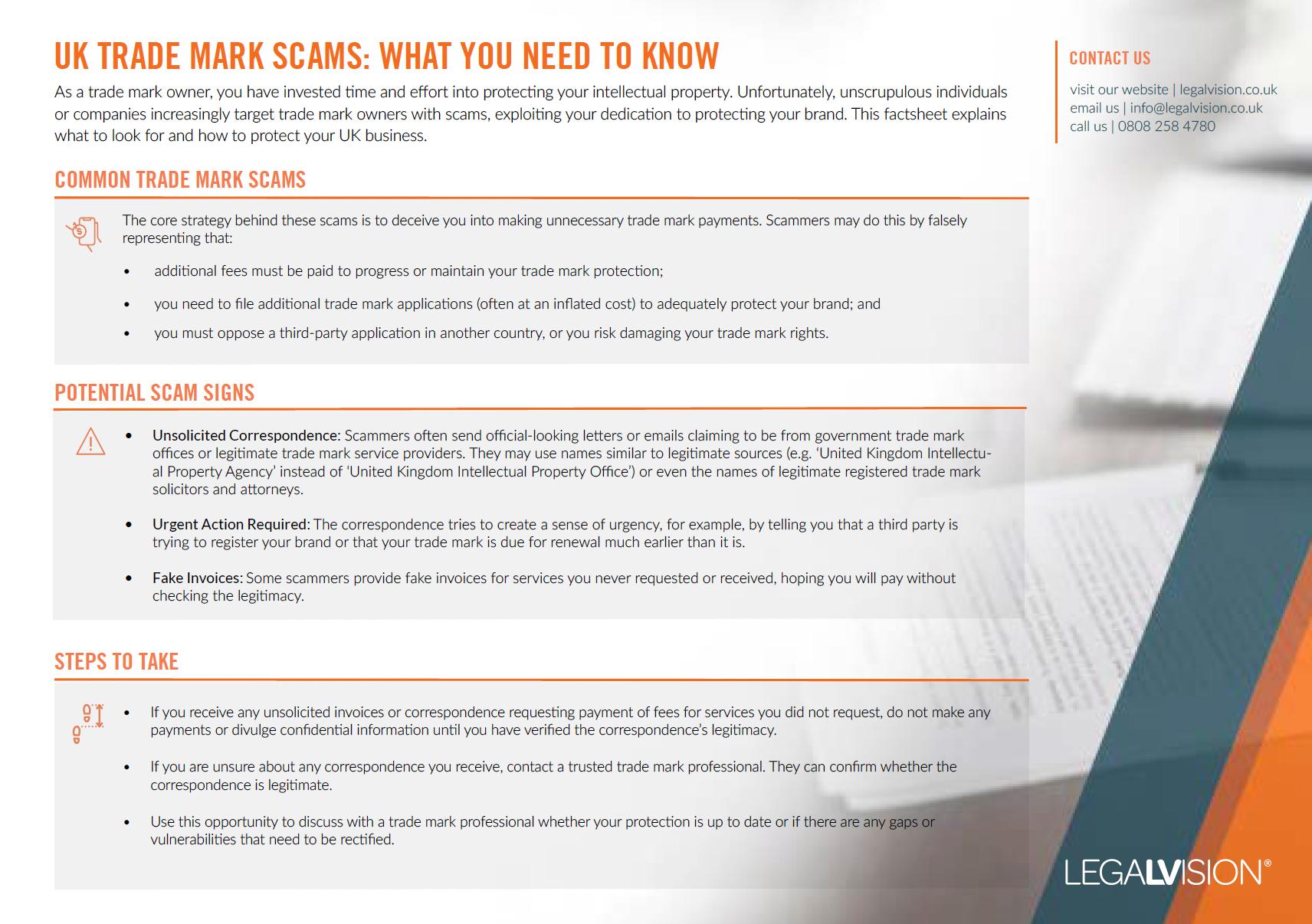
Increasingly, unscrupulous individuals or companies target trade mark owners with scams, exploiting your dedication to protecting your brand. This factsheet explains what to look for and how to protect your UK business.
What Are Patents?
A patent is a type of intellectual property usually granted to someone who has invented something entirely new and unique. The UK Intellectual Property Office (IPO) deals with granting new patents to applicants, and there are very stringent criteria that you must meet to be successful.
If the IPO grants your patent, this protection is only valid inside the jurisdiction of the country you apply in. Therefore, you will not be able to automatically enforce your intellectual property rights worldwide and instead need to make other applications, for instance, by using the European Patent Convention. This provides an application service to patent a new invention in multiple European countries using only one application.
However, it is worth noting that multiple patent applications must be filed within 12 months if they all fall under the same invention. This is due to the requirement specific to patents – that an invention is new to the public.
What Can Patents Be Used For?
Firstly, it is easier to consider what you cannot patent. For instance, there is a strict list of items that cannot be successfully patented, including:
- a discovery, scientific or mathematical method;
- an artistic, musical, and literary creation;
- a new method of performing something; or
- a way to present information.
If your invention does not fall into the above categories, it could still be patentable. However, there are other obstacles still to overcome.
While patents safeguard new inventions, you must understand that you cannot patent every invention. Firstly, the invention must be entirely new for the public, meaning it has never been launched in any sphere, including academia. It must also be inventive, meaning it must be a new concept entirely and not simply a slight modification of an already established object. Finally, the invention must also be capable of industrial application, meaning it should be practically applicable within any industry.
Continue reading this article below the formCall 0808 196 8584 for urgent assistance.
Otherwise, complete this form, and we will contact you on the same business day.
How Long Do Patents Last in the UK?
Simply put, a UK patent can last up to 20 years. However, this is the maximum and includes multiple annual renewal terms. Therefore, you can not renew beyond the 20-year limit. However, in the case of medicine or plant protection provided by patents, you can protect these inventions for a further five years, subject to granting a supplementary protection certificate.
These certificates aim to compensate the applicant who applied for the patent due to the time it takes to obtain regulatory approval for a product that falls under the medicinal or plant categories. It does not extend the actual patent itself. This certificate merely extends the protections that the patent has previously provided.
Do I Need a Patent?
Patents are not a legal requirement and are more of a luxury than a necessity. However, patents provide intellectual property protection, which stops other people from copying your invention and financially gaining from your ideas and creativity. That being so, you do not need to patent a product. If you are content with others copying your invention, it may be a completely unnecessary process for your business.
Patents provide a right for you to launch a legal dispute against anyone who attempts to use or sell your invention without permission. Consequently, it provides a strong level of protection and is an essential deterrent for competitors who may be considering stealing your idea. But ultimately, it is a personal decision, and you need to factor in the cost, length of time and financial viability of your invention before deciding whether you will make an application to the IPO.
What Happens If Someone Copies Your Invention?
If someone uses your patented invention without permission, you can take legal action against them. This is called patent infringement. You can apply to the courts to stop them from continuing and claim financial compensation for any losses you have suffered.
Before going to court, many businesses send a cease and desist letter first. This puts the other party on notice and often resolves the issue without litigation.
If you are unsure whether your rights have been infringed, the UK Intellectual Property Office offers a free mediation service. This can help both parties reach an agreement without the cost of court proceedings.
Keep records of your invention’s development from the start. Dated notes, drawings, and prototypes can support your case if a dispute arises later.
Key Takeaways
Patent protection is a type of intellectual property law that allows you to take legal action against anyone commercially exploiting your invention without your permission. It stops others from copying, manufacturing or selling your invention and provides a strong security level.
Patent protection lasts up to 20 years in England and Wales, depending on your decision to renew it annually, where you will accrue renewal fees. If your invention falls into the medicinal or plant category, it may also be given an extra five years of protection and a certificate. However, your protection will only be valid within England. You must launch separate applications to expand this protection to other jurisdictions. This can be important if your company is multi-national and your competitors are also across several countries.
Frequently Asked Questions
How long does patent protection last?
It lasts for 20 years if you renew the patent annually. It cannot extend beyond this period unless your invention is either medicinal or plant in character. In that case, the protection could extend for five years more.
Can I patent a new method of doing something?
Patents protect new inventions that can be utilised in industry. Therefore, methods of doing something, such as new mathematical or programming methods, are generally excluded from patenting.
Does a UK patent protect me worldwide?
No. You must file separate applications for other jurisdictions.
What is a supplementary protection certificate?
It extends patent protections for medicinal or plant inventions by five years.
We appreciate your feedback! Request your free consultation now.


