


In Short
-
Businesses that process children’s personal data must apply extra care under UK data protection laws.
-
This includes using clear, child-friendly privacy information and building strong safeguards into systems from the start.
-
Mishandling children’s data can lead to legal risk, regulatory action, and long-term harm.
Tips for Businesses
If your products or services are used by children, review how you collect, explain, store, and share their data. Use age-appropriate privacy notices, collect only what you genuinely need, and set high privacy defaults. Regularly assess risks through DPIAs, limit internal access to children’s data, and be cautious when using AI or sharing data for safeguarding purposes.
Summary
This article explains the key UK data protection rules that apply when businesses process children’s personal data, aimed at business owners and operators in the United Kingdom. Prepared by LegalVision, a commercial law firm specialising in advising clients on data protection and privacy law, it outlines the legal framework, key risks, and practical considerations for protecting children’s information.


Businesses that offer products or services to a young audience or customer base may gain access to various personal information about children, including data collected through online platforms and apps, as well as e-commerce or educational services that children use.
The UK’s data protection law regime imposes strict obligations on how businesses may use and protect children’s information. Given that children may be less aware of the risks and may not fully understand how their data is processed, the use of children’s data by a business requires additional and careful consideration, including the need to explain your data protection practices in clear, plain language that children understand. If you are a business that processes personal data about children, it is essential to adopt strong safeguards and design your processing with children’s protection in mind from the outset.
This article explores the UK’s data protection law regime, some critical considerations for protecting children’s data, and the importance of seeking tailored legal advice to help your business protect children’s data and mitigate risk.
The UK Data Protection Law Framework
The UK data protection regime is made up of the UK GDPR and the Data Protection Act 2018. These laws set out a range of mandatory rules that apply when personal data is processed.
The Data (Use and Access) Act 2025 also forms a part of the UK’s privacy landscape and is a law that is being brought into force in phases through secondary legislation. Whilst not a specific data protection law, it brings targeted amendments to the current data protection framework and imposes further compliance duties.
The general rules under the UK GDPR apply when a business processes children’s personal data. The law states that children require additional safeguards because they may be less aware of:
- the risks;
- consequences; and
- their rights.
Why Children’s Data Needs Significant Protection
Children may not appreciate the risks of sharing their information or understand how an organisation will use their data. A wide range of information may be processed about children, such as:
- their health details;
- performance data;
- biometric identifiers or behavioural; and
- usage data captured by digital platforms.
If a business mishandles such information, children may face harm or long-term consequences. As such, key protections to safeguard children are vital – particularly given their increased vulnerability.
Protecting children’s personal data is a key legal obligation and a fundamental trust issue. Parents will expect businesses to safeguard children’s information, and this expectation can strongly influence trust and business success. If your business manages children’s data securely and complies with data protection laws when doing so, you may be able to strengthen your reputation as a data-responsible and trustworthy business.
Continue reading this article below the formCall 0808 196 8584 for urgent assistance.
Otherwise, complete this form, and we will contact you within one business day.
Key Considerations When You Process Children’s Data
Various legal considerations and rules can apply to protect children’s personal data, and there are broad issues to understand if your business processes children’s information.
Providing Transparency and Age-Appropriate Privacy Information
You must ensure that privacy information disclosing how you use data about children is clear, concise and appropriate for a child’s level of understanding. This is commonly achieved with a children’s privacy policy. If your service covers different age groups, you may need separate versions or consider a version suitable for the youngest users.
You should consider using:
- diagrams;
- graphics;
- layered explanations;
- icons; or
- just-in-time notices to help children understand what data you collect from them and why.
Privacy by Design and Default
You must design your systems, products and services with children in mind from the outset. Privacy by design and default includes:
- setting high default privacy settings;
- limiting data collection to only what is necessary; and
- providing clear explanations before enabling any data-sharing features.
Involving children in testing or feedback can help you identify risks and design adequate safeguards.
Data Protection Impact Assessments (DPIAs)
You should use DPIAs (data protection risk assessments) to assess and reduce risks to the personal data of children. You must complete a DPIA whenever your processing creates a high risk to a child’s rights and freedoms.
Security, Accuracy and Data Minimisation
You must collect only the minimum amount of data that you need, keep it accurate and delete it once it is no longer required. Strong security measures are crucial, and access to children’s information should be limited to those who genuinely need it.
Children’s Rights
Children hold the same rights as adults under the UK GDPR. They may exercise these rights independently where they have the competency to do so or may do so via an adult with parental responsibility. You must give children clear and simple ways to exercise their data rights and seek legal advice if you need guidance on how to do so.
Data Sharing for Safeguarding
If you need to share children’s information to safeguard a child, you must do so lawfully and follow the data protection regulator’s guidance and apply responsible data-sharing practices.
Children’s Data and AI
AI use is increasingly prevalent in the UK and globally. If you use children’s information in connection with AI systems, you must apply:
- transparency;
- accountability; and
- suitable safeguards.
This can be high-risk and is a fast-developing area, so you should seek legal advice when training AI models that use children’s data or allow children to use AI tools.
Seeking Tailored Legal Advice to Prevent Risk
Processing children’s personal data can be one of the most sensitive and high-risk areas, given the additional vulnerability of children.
You may face additional and complex compliance rules if your business:
- works with young users;
- provides services that children are likely to access; or
- handles sensitive categories of children’s information.
Many areas of compliance require a nuanced and careful assessment, such as:
- complexities around data transparency;
- conducting correct DPIAs; and
- complying with the Children’s Code where necessary.
Given the complexity and consequences of non-compliance, businesses can benefit significantly from tailored legal advice. A data protection lawyer can assess your practices for processing children’s data, identify risk areas, help you address them, and implement safeguards to reduce risk and build trust in your business.
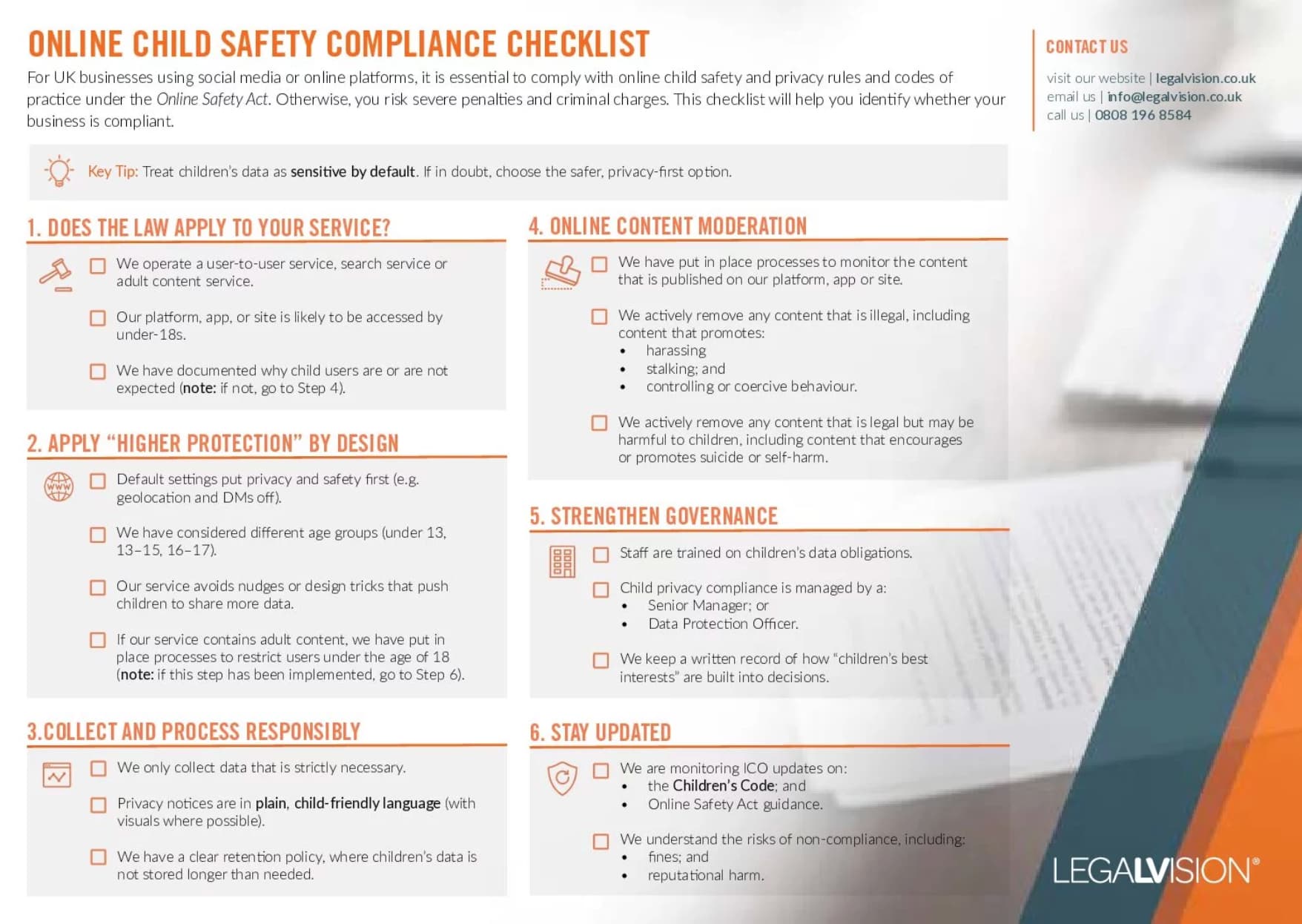
This checklist will help you identify whether your business is compliant with privacy rules and codes of practice under the Online Safety Act.
Key Takeaways
Businesses must comply with all relevant data protection laws with heightened care when processing any children’s personal data. Important considerations include:
- the need to communicate in a language children can understand;
- apply privacy by design and default; and
- to follow additional rules under the Children’s Code where necessary.
Given that the use of children’s data is sensitive and high-risk, your business should seek legal advice from a data protection solicitor to understand your specific duties and put in place safeguards to protect the personal data of children and reduce risk.
LegalVision provides ongoing legal support for businesses through its fixed-fee legal membership. Our lawyers help businesses in the recruitment industry manage contracts, employment law, disputes, intellectual property, and more. Members receive unlimited access to specialist lawyers for a fixed monthly fee. To learn more, call 0808 196 8584 or visit our membership page.
Frequently Asked Questions
If your business processes children’s personal data or offers services that children are likely to use, you must provide privacy information that children can understand to tell children about how and why you use their data. You may need different versions for different age groups.
Processing children’s personal data carries heightened regulatory risk, and breaching legal rules can have heavy reputational consequences too. Legal advice is sensible as it can help you understand your duties, identify risks and ensure your practices comply with legal rules.
We appreciate your feedback – your submission has been successfully received.


